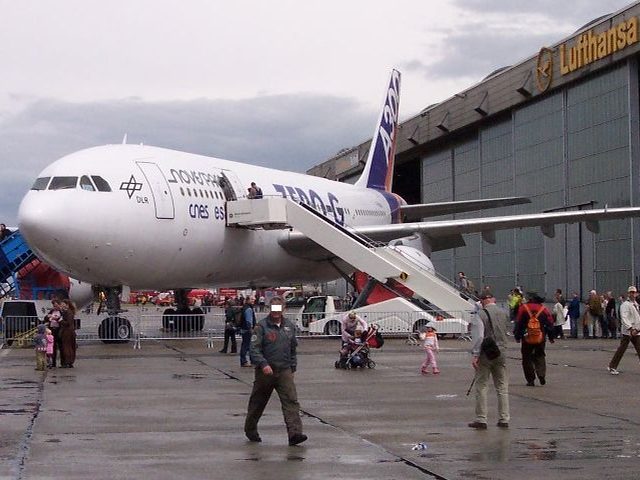
Airbus A300-B2
Twin Jet· 3 globally registered
The Airbus A300 was the world's first twin-engine widebody airliner, entering service in 1974 and fundamentally reshaping the economics of medium-haul air travel. Designed as a European answer to American dominance in commercial aviation, it proved that two engines could safely and efficiently power a widebody across oceanic routes, a capability that regulators initially doubted but which became the foundation for the modern twin-jet era. The A300B variants (B2 and B4) were the original production models, seating 250-290 passengers and powered by General Electric CF6 or Pratt & Whitney JT9D turbofans. While Airbus struggled with early sales, the type eventually found its stride with airlines seeking lower operating costs than trijets like the DC-10 or L-1011, and it launched Airbus as a credible competitor to Boeing. The A300's wing design and fly-by-wire experiments on later variants directly influenced the A320 family. After passenger service wound down in the 2000s, the A300 found a strong second life as a freighter. FedEx became the largest operator of A300 conversions, prizing the type's capacious main deck, reliable twin-engine simplicity, and ability to carry up to 54,000 pounds of cargo on overnight express routes. The aircraft's maximum operating speed of Mach 0.86 and service ceiling of 40,000 feet made it competitive with purpose-built freighters, while conversion costs remained lower than acquiring new aircraft. Though production ended in 2007 with the final A300-600, the type remains a workhorse in the cargo world. SkyMeter has tracked 83 flights across 16 airframes and 3 operators, with FEDERAL EXPRESS CORP the largest observed operator.
Safety in context
The incident rate counts flights with ANY safety event detected by SkyMeter: go-arounds (a routine response, not a failure), unstable-approach gate flags (advisory thresholds), rejected takeoffs (the system working as designed), and runway events. It is NOT an accident rate or fatality rate. For accident statistics, refer to the NTSB Aviation Accident Database (USA) or the Aviation Safety Network. See methodology for what each event type measures.
Performance
Speed envelope & approach
Dimensions
Airframe geometry
Weight & identification
Operating limits
Top operators
By fleet size · last 7 days

Safety profile
Flagged flights · last 7 days
Family
Related variants
Recent incidents
Flagged flights of A30B


Recent flights
Real flights of A30B · airborne ≥ 20 min