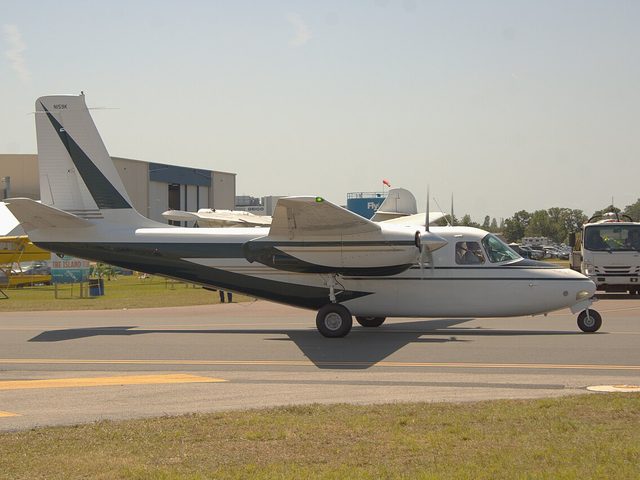
Aero Commander 500
Twin Piston· 169 globally registered
The Aero Commander 500 series represents one of the most successful light twin-engine business aircraft of the 1950s and 1960s, establishing a reputation for rugged reliability that keeps examples flying worldwide more than six decades after the first deliveries. Designed by Ted Smith and first flown in 1948, the Commander pioneered the high-wing, twin-engine executive transport configuration that would influence countless later designs. Its distinctive profile, with engines mounted on a straight wing well above the fuselage, provided excellent visibility and ground clearance, making it popular for corporate transport, air ambulance work, and charter operations across challenging terrain from the Australian outback to remote airstrips in Alaska. The type earned particular fame when President Dwight Eisenhower used an Aero Commander as his personal aircraft, the first time a sitting U.S. president regularly flew in a civilian plane. The 500 series evolved through numerous variants with progressively more powerful engines, culminating in models like the 500S and 500U that could cruise at 215 knots and reach altitudes above 20,000 feet. That was impressive performance for a piston twin of its era. Its operating envelope spans from a stall speed around 65 knots in landing configuration to a never-exceed speed of 230 knots, with a maximum structural cruising speed of 195 knots that allowed comfortable cross-country travel at 180-200 knots true airspeed in the flight levels. While production ended in the 1980s, the Commander's sturdy construction and straightforward systems have ensured strong support from type clubs and specialty maintenance shops, particularly in Australia and North America where significant fleets remain active in utility roles. SkyMeter has tracked 298 flights across 57 airframes and 30 operators, with CENTRAL AIRLINES INC the largest observed operator.
Safety in context
The incident rate counts flights with ANY safety event detected by SkyMeter: go-arounds (a routine response, not a failure), unstable-approach gate flags (advisory thresholds), rejected takeoffs (the system working as designed), and runway events. It is NOT an accident rate or fatality rate. For accident statistics, refer to the NTSB Aviation Accident Database (USA) or the Aviation Safety Network. See methodology for what each event type measures.
Performance
Speed envelope & approach
Dimensions
Airframe geometry
Weight & identification
Operating limits
Top operators
By fleet size · last 7 days


Safety profile
Flagged flights · last 7 days
Family
Related variants
Recent incidents
Flagged flights of AC50

Recent flights
Real flights of AC50 · airborne ≥ 20 min
