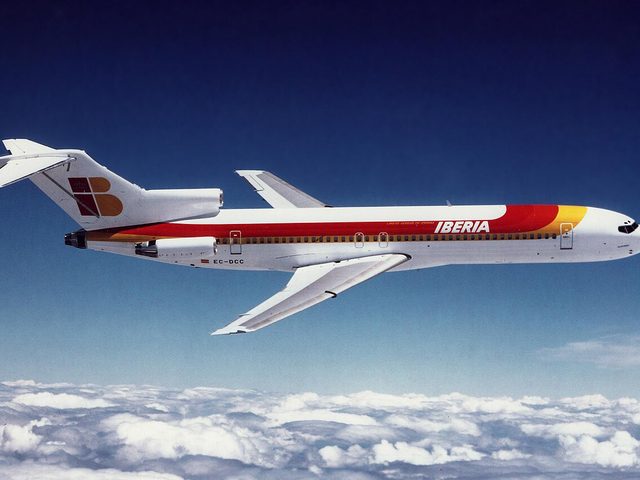
Boeing 727-200
Twin Jet· 41 globally registered
The Boeing 727-200 was the stretched, higher-capacity variant of Boeing's iconic trijet narrowbody, introduced in 1967 to meet airline demand for more seats on the same airframe. Seating up to 189 passengers compared to the original 727-100's 131, the -200 became the workhorse of the 727 family and one of the most commercially successful jetliners of its era, with 1,260 units delivered before production ended in 1984. Its distinctive T-tail and three rear-mounted Pratt & Whitney JT8D turbofans gave it exceptional short-field performance and the ability to operate from airports without ground support equipment, making it ideal for secondary cities and challenging airfields across the Americas, Africa, and the Middle East. The 727-200 could cruise at Mach 0.90 and reach altitudes up to 42,000 feet, competitive with contemporary twinjets but with the added safety margin of a third engine over remote terrain and water. While passenger operations have largely ceased in North America and Europe, the type remains active in cargo service and with smaller operators in developing markets, prized for its rugged reliability and low acquisition cost. The aircraft's steep approach capability, thanks to triple-slotted trailing-edge flaps and leading-edge devices, allowed it to serve airports with noise restrictions that would challenge modern twins. SkyMeter has tracked 20 flights across 5 airframes and 4 operators over routes, with USA JET AIRLINES INC the largest observed operator.
Safety in context
The incident rate counts flights with ANY safety event detected by SkyMeter: go-arounds (a routine response, not a failure), unstable-approach gate flags (advisory thresholds), rejected takeoffs (the system working as designed), and runway events. It is NOT an accident rate or fatality rate. For accident statistics, refer to the NTSB Aviation Accident Database (USA) or the Aviation Safety Network. See methodology for what each event type measures.
Performance
Speed envelope & approach
Dimensions
Airframe geometry
Weight & identification
Operating limits
Top operators
By fleet size · last 7 days


Safety profile
Flagged flights · last 7 days
Family
Related variants
Recent incidents
Flagged flights of B722


Recent flights
Real flights of B722 · airborne ≥ 20 min
