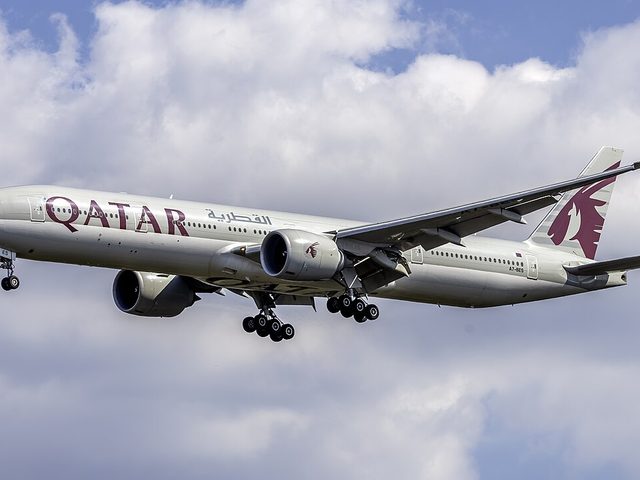
Boeing 777-300er
Twin Jet· 51 globally registered
The Boeing 777-300ER is the world's most successful long-range widebody twin, a stretched ultra-long-haul variant that redefined intercontinental aviation when it entered service in 2004. With a maximum range of 7,370 nautical miles and seating for 350-400 passengers in typical three-class layouts, the 777-300ER became the backbone of long-haul fleets worldwide, effectively replacing aging 747-400s on routes where four engines were no longer economically justified. Its GE90-115B engines are the most powerful jet engines ever mounted on a commercial aircraft, each producing up to 115,000 pounds of thrust and enabling the type to operate from high-altitude airports and carry full payloads across the Pacific. Boeing designed the 777-300ER with a maximum takeoff weight of 775,000 pounds and a service ceiling of 43,100 feet, giving it exceptional flexibility for nonstop city pairs like Los Angeles to Melbourne or New York to Hong Kong. The type's advanced fly-by-wire system, composite materials in the empennage and floor beams, and sophisticated avionics made it one of the most reliable widebodies in service, with dispatch reliability consistently above 99 percent. Airlines valued its commonality with the shorter 777-200ER, allowing pilots to operate both variants on a single type rating, and its lower seat-mile costs compared to the 747 or A340 made it the preferred choice for premium long-haul routes. The 777-300ER dominated the ultra-long-haul market for nearly two decades until the arrival of the 787 and A350, but it remains in widespread service with major carriers who prize its proven economics and passenger appeal. Its cruise speed of Mach 0.84 and maximum operating speed of Mach 0.89 keep block times competitive, while its spacious cabin cross-section, the widest of any twin-aisle jet at 231 inches, offers a comfortable passenger experience on fifteen-hour sectors. SkyMeter has tracked 6,425 flights across 713 airframes and 7 operators, with Air Canada the largest observed operator.
Safety in context
The incident rate counts flights with ANY safety event detected by SkyMeter: go-arounds (a routine response, not a failure), unstable-approach gate flags (advisory thresholds), rejected takeoffs (the system working as designed), and runway events. It is NOT an accident rate or fatality rate. For accident statistics, refer to the NTSB Aviation Accident Database (USA) or the Aviation Safety Network. See methodology for what each event type measures.
Performance
Speed envelope & approach
Dimensions
Airframe geometry
Weight & identification
Operating limits
Top operators
By fleet size · last 7 days


Safety profile
Flagged flights · last 7 days
Family
Related variants
Recent incidents
Flagged flights of B77W


Recent flights
Real flights of B77W · airborne ≥ 20 min


