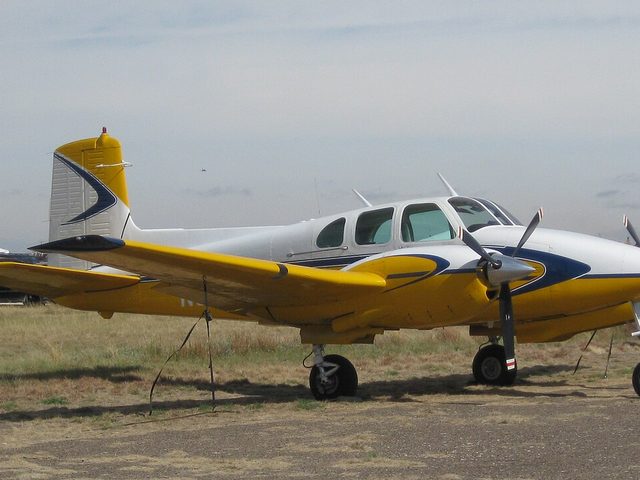
Beechcraft 50 Twin Bonanza
Twin Piston· 123 globally registered
The Beechcraft Twin Bonanza was the company's first twin-engine civilian aircraft, introduced in 1951 as a larger, more capable sibling to the legendary single-engine Bonanza. Designed for corporate transport and light cargo work, the Twin Bonanza featured two 260-horsepower Lycoming engines and could carry up to six passengers in relative comfort, a significant step up from the cramped twins of the immediate postwar era. Beechcraft built approximately 950 examples between 1952 and 1963, and the type became a workhorse for small airlines, air taxi operators, and corporate flight departments across North America. What set the Twin Bonanza apart was its rugged construction and genuine utility. Unlike many light twins that struggled with single-engine performance, the BE50 offered respectable climb rates and handling characteristics that made it popular with professional pilots. The aircraft's distinctive nose profile and spacious cabin made it instantly recognizable on the ramp, and its ability to operate from shorter runways opened up destinations that larger twins couldn't reach. Military variants served with the U.S. Army as the L-23 Seminole, further proving the design's versatility. Today the Twin Bonanza remains a capable platform for personal and light commercial operations, prized by owners who value its solid handling and classic lines. The type cruises around 195 knots and can reach altitudes above 20,000 feet, though most operators fly lower for efficiency. Parts support remains adequate thanks to a dedicated owner community and aftermarket suppliers. SkyMeter has tracked 34 flights across 14 airframes and 13 operators, with NIGHTINGALE MATTHEW M the largest observed operator.
Safety in context
The incident rate counts flights with ANY safety event detected by SkyMeter: go-arounds (a routine response, not a failure), unstable-approach gate flags (advisory thresholds), rejected takeoffs (the system working as designed), and runway events. It is NOT an accident rate or fatality rate. For accident statistics, refer to the NTSB Aviation Accident Database (USA) or the Aviation Safety Network. See methodology for what each event type measures.
Performance
Speed envelope & approach
Dimensions
Airframe geometry
Weight & identification
Operating limits
Top operators
By fleet size · last 7 days


Safety profile
Flagged flights · last 7 days
Family
Related variants
Recent incidents
Flagged flights of BE50


Recent flights
Real flights of BE50 · airborne ≥ 20 min
