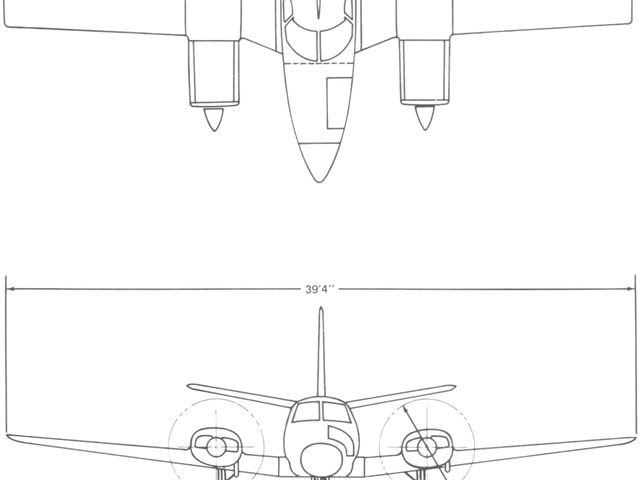
Beech 60 Duke
Twin Piston· 266 globally registered
The Beechcraft Duke is a pressurized twin-engine piston aircraft that represented the pinnacle of Beechcraft's cabin-class piston line when production began in 1968. Powered by two turbocharged Lycoming TIO-541 engines producing 380 horsepower each, the Duke was designed to compete with light turboprops by offering pressurization, high cruise speeds around 230 knots, and a service ceiling of 30,000 feet, capabilities that set it apart from unpressurized twins like the Baron. The aircraft's distinctive T-tail and sleek fuselage made it instantly recognizable on the ramp, though its complexity and operating costs earned it a reputation as a demanding but rewarding machine for experienced pilots. Production ran until 1982 with approximately 596 Dukes built across several variants, including the A60, B60, and turbine-converted models. The B60, introduced in 1974, became the most refined version with improved systems and aerodynamics. Despite its performance advantages, the Duke never achieved the commercial success of its simpler Baron sibling, largely due to higher acquisition and maintenance costs during an era when turboprops were becoming increasingly accessible. The type found its niche among owner-pilots who valued its pressurized comfort and speed for personal and business travel, as well as with air ambulance operators who appreciated the cabin space and high-altitude capability. Today the Duke remains a respected if uncommon sight, prized by enthusiasts for its performance envelope and the engineering ambition it represented in the piston-twin category. Its pressurization system, while maintenance-intensive, allows comfortable flight above most weather, and its cruise performance still competes favorably with modern piston twins. SkyMeter has tracked 87 flights across 36 airframes and 36 operators, with REITER KENNETH L the largest observed operator.
Safety in context
The incident rate counts flights with ANY safety event detected by SkyMeter: go-arounds (a routine response, not a failure), unstable-approach gate flags (advisory thresholds), rejected takeoffs (the system working as designed), and runway events. It is NOT an accident rate or fatality rate. For accident statistics, refer to the NTSB Aviation Accident Database (USA) or the Aviation Safety Network. See methodology for what each event type measures.
Performance
Speed envelope & approach
Dimensions
Airframe geometry
Weight & identification
Operating limits
Top operators
By fleet size · last 7 days


Safety profile
Flagged flights · last 7 days
Family
Related variants
Recent incidents
Flagged flights of BE60


Recent flights
Real flights of BE60 · airborne ≥ 20 min
