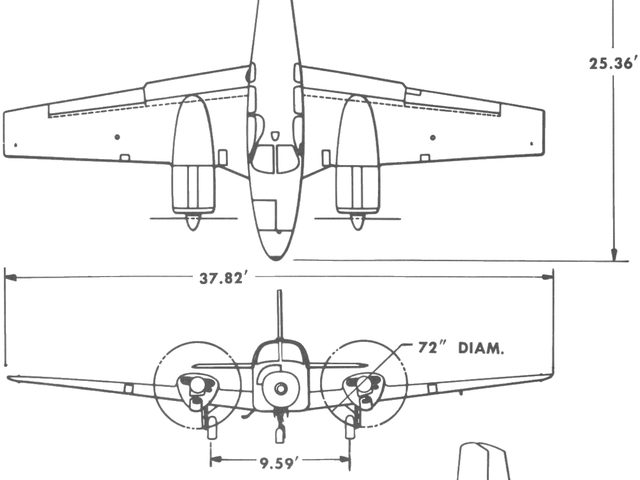
Beechcraft 95 Travel Air
Twin Piston· 262 globally registered
The Beechcraft Travel Air, introduced in 1956, was the company's first light twin-engine aircraft designed for the owner-pilot market. Built as a more affordable alternative to the Twin Bonanza, the Travel Air combined the fuselage of the Bonanza single with a new wing mounting two 180-horsepower Lycoming engines. It seated four to five occupants and offered genuine twin-engine safety and performance at a price point accessible to successful professionals and small charter operators. The type proved popular enough that Beechcraft produced over 700 examples through 1968, and the design directly evolved into the Baron line that remains in production today. The Travel Air's operating envelope reflected its role as a capable cross-country cruiser: it climbed at around 1,200 feet per minute, cruised at 180 knots true airspeed at altitude, and could reach a service ceiling near 20,000 feet. Single-engine performance was modest but adequate, with a single-engine ceiling around 6,800 feet at gross weight. The aircraft's relatively low stall speeds and docile handling made it a popular trainer for multi-engine ratings, though pilots transitioning from singles had to respect its higher approach speeds and the need for proper engine-out procedures. Today the Travel Air remains a fixture of general aviation, valued for its rugged construction, parts commonality with the Baron family, and straightforward systems. Many examples have been upgraded with modern avionics and improved interiors, extending their utility well into the 21st century. SkyMeter has tracked 688 flights across 225 airframes and 219 operators, with SANDERS AVIATION INC the largest observed operator.
Safety in context
The incident rate counts flights with ANY safety event detected by SkyMeter: go-arounds (a routine response, not a failure), unstable-approach gate flags (advisory thresholds), rejected takeoffs (the system working as designed), and runway events. It is NOT an accident rate or fatality rate. For accident statistics, refer to the NTSB Aviation Accident Database (USA) or the Aviation Safety Network. See methodology for what each event type measures.
Performance
Speed envelope & approach
Dimensions
Airframe geometry
Weight & identification
Operating limits
Top operators
By fleet size · last 7 days


Safety profile
Flagged flights · last 7 days
Family
Related variants
Recent incidents
Flagged flights of BE95


Recent flights
Real flights of BE95 · airborne ≥ 20 min


