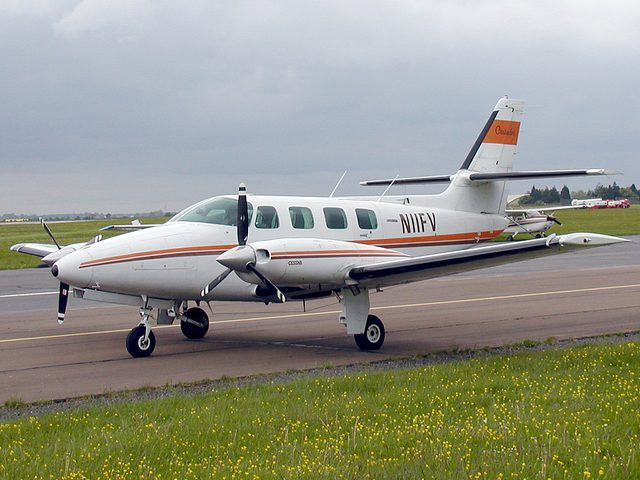
Cessna 303 Crusader
Twin Piston· 57 globally registered
The Cessna T303 Crusader is a light twin-engine piston aircraft that Cessna produced from 1981 to 1986, designed to bridge the gap between the company's smaller trainers and its pressurized cabin-class twins. With counter-rotating Continental TSIO-520 turbocharged engines producing 250 horsepower each, the Crusader was marketed as a step-up aircraft for owner-pilots seeking the safety margin of a second engine without the complexity and operating costs of larger twins. Its distinctive T-tail configuration and relatively spacious six-seat cabin made it popular among small charter operators and affluent private owners during the 1980s. Cessna built approximately 315 Crusaders before discontinuing the line in 1986, making it one of the rarer cabin-class twins still flying today. The aircraft cruises at around 180 knots and can reach altitudes up to 25,000 feet with its turbocharged powerplants, offering respectable performance for a piston twin of its era. The type never achieved the commercial success Cessna hoped for, facing stiff competition from Piper's Seneca and Beechcraft's Baron, and production ended after just five years. Despite its short production run, the Crusader developed a loyal following among pilots who appreciated its handling characteristics and relatively benign single-engine performance. Today the T303 serves primarily in private ownership, air taxi operations, and specialized roles like pipeline patrol and aerial survey work. Its operating envelope includes a never-exceed speed of 202 knots, a maximum structural cruising speed of 169 knots, and stall speeds of 59 knots with full flaps and 65 knots clean, figures that place it squarely in the middle of the light twin category. SkyMeter has tracked 45 flights across 21 airframes and 14 operators, with APPLEGATE PROPERTIES LLC the largest observed operator.
Safety in context
The incident rate counts flights with ANY safety event detected by SkyMeter: go-arounds (a routine response, not a failure), unstable-approach gate flags (advisory thresholds), rejected takeoffs (the system working as designed), and runway events. It is NOT an accident rate or fatality rate. For accident statistics, refer to the NTSB Aviation Accident Database (USA) or the Aviation Safety Network. See methodology for what each event type measures.
Performance
Speed envelope & approach
Dimensions
Airframe geometry
Weight & identification
Operating limits
Top operators
By fleet size · last 7 days


Safety profile
Flagged flights · last 7 days
Family
Related variants
Recent incidents
Flagged flights of C303


Recent flights
Real flights of C303 · airborne ≥ 20 min

