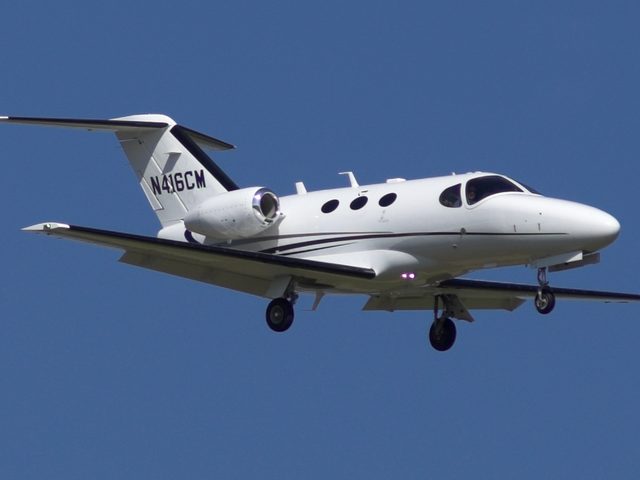
Cessna Citation Mustang
Twin Jet· 287 globally registered
The Cessna Citation Mustang holds the distinction of being the first very light jet certified by the FAA, earning its type certificate in September 2006 and entering service that same year. Designed as an owner-flown entry point into jet aviation, the Mustang bridged the gap between high-performance turboprops and traditional light jets, offering jet speed and altitude capability at a price point and operating cost that made single-pilot jet ownership newly accessible to successful professionals and small charter operators. With seating for four passengers plus a pilot and powered by two Pratt & Whitney Canada PW615F turbofans, the Mustang cruises at 340 knots and reaches a service ceiling of 41,000 feet, performance that allows it to overfly most weather and traffic while burning roughly 80 gallons per hour. Its 1,150-nautical-mile range made it ideal for regional business travel, air ambulance missions, and flight training for aspiring jet pilots. Production ran from 2006 to 2017, with 479 aircraft delivered worldwide before Cessna discontinued the line to focus on the larger Citation M2. The Mustang's compact size (just 40 feet long with a 43-foot wingspan) allows it to operate from shorter runways than most jets, opening access to thousands of general aviation airports. Its relatively simple systems and docile handling characteristics made it popular with owner-pilots transitioning from piston twins and turboprops, though its light weight and modest thrust require careful attention to performance planning in hot-and-high conditions. The type found particular favor in air ambulance operations, where its pressurized cabin, medical equipment capacity, and ability to reach remote airstrips quickly proved invaluable. SkyMeter has tracked flights across airframes and operators, with the largest observed operator.
Safety in context
The incident rate counts flights with ANY safety event detected by SkyMeter: go-arounds (a routine response, not a failure), unstable-approach gate flags (advisory thresholds), rejected takeoffs (the system working as designed), and runway events. It is NOT an accident rate or fatality rate. For accident statistics, refer to the NTSB Aviation Accident Database (USA) or the Aviation Safety Network. See methodology for what each event type measures.
Performance
Speed envelope & approach
Dimensions
Airframe geometry
Weight & identification
Operating limits
Top operators
By fleet size · last 7 days
No operator data available.
Safety profile
Flagged flights · last 7 days
No safety data available.
Family
Related variants
No related variants.
Recent incidents
Flagged flights of C510


Recent flights
Real flights of C510 · airborne ≥ 20 min


