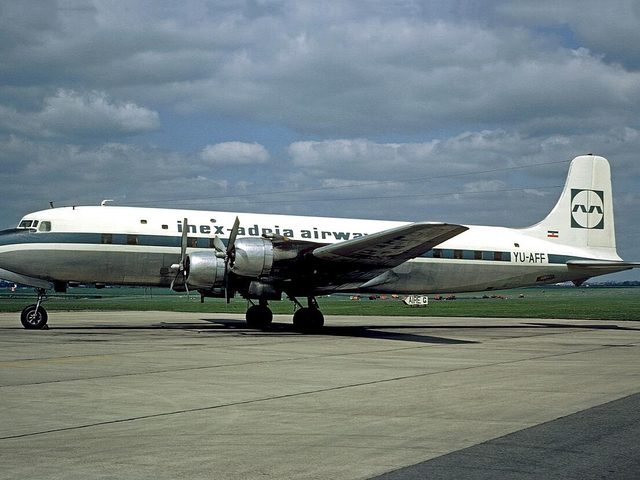
Douglas Dc 6
Quad Piston· 30 globally registered
The Douglas DC-6 was the piston-powered heavyweight that ruled long-haul air travel in the early postwar years, bridging the gap between the legendary DC-3 and the coming jet age. Introduced in 1947 as a pressurized, four-engine airliner powered by Pratt & Whitney R-2800 Double Wasp radials producing 2,500 horsepower each, the DC-6 could carry up to 102 passengers across transcontinental and transoceanic routes at altitudes above 20,000 feet, a quantum leap in comfort and speed over its unpressurized predecessors. Airlines like United, American, and Pan Am deployed hundreds of DC-6s on premier routes throughout the 1950s, with the type setting multiple speed records including the first sub-10-hour transcontinental crossing by a commercial airliner. With a maximum takeoff weight of 107,000 pounds and a range exceeding 3,000 nautical miles, the DC-6 offered genuine intercontinental capability in an era when most airliners were still regional workhorses. The improved DC-6B variant, which became the production standard, featured a strengthened fuselage and increased fuel capacity, cementing the type's reputation for rugged reliability. Though passenger service ended by the early 1970s as jets took over, the DC-6 found a lucrative second career as a freighter and fire tanker, with its powerful radial engines and rugged airframe proving ideal for heavy cargo operations in remote environments like Alaska and northern Canada. Today the DC-6 remains one of the last operational four-engine piston airliners, prized by specialty cargo operators for its ability to haul oversized loads into short, unpaved strips where turbine aircraft fear to tread. The type's distinctive sound (the deep, syncopated rumble of four radials slightly out of phase) is now a rare treat at airshows and backcountry operations. SkyMeter has tracked 11 flights across 4 airframes and 3 operators, with TATONDUK OUTFITTERS LTD the largest observed operator.
Safety in context
The incident rate counts flights with ANY safety event detected by SkyMeter: go-arounds (a routine response, not a failure), unstable-approach gate flags (advisory thresholds), rejected takeoffs (the system working as designed), and runway events. It is NOT an accident rate or fatality rate. For accident statistics, refer to the NTSB Aviation Accident Database (USA) or the Aviation Safety Network. See methodology for what each event type measures.
Performance
Speed envelope & approach
Dimensions
Airframe geometry
Weight & identification
Operating limits
Top operators
By fleet size · last 7 days


Safety profile
Flagged flights · last 7 days
Family
Related variants
No related variants.
Recent incidents
Flagged flights of DC6
Recent flights
Real flights of DC6 · airborne ≥ 20 min

