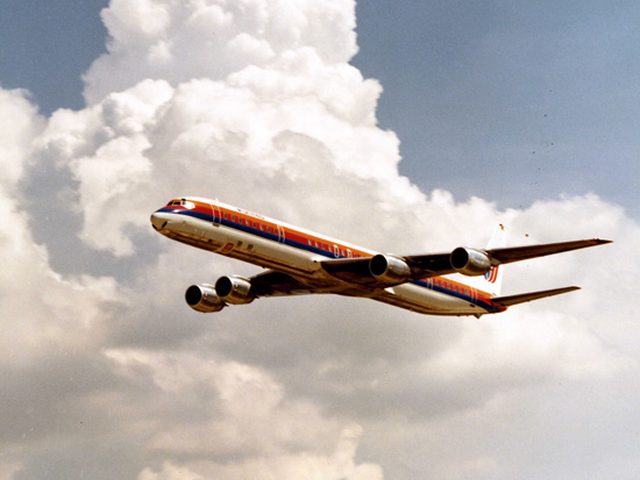
Douglas Dc-8-70
Quad Jet· 6 globally registered
The Douglas DC-8-70 series represents one of aviation's most successful re-engining programs, transforming the classic 1950s-era DC-8 into a fuel-efficient freighter that remained competitive well into the 21st century. Starting in 1981, Cammacorp (later merged into Pemco) began retrofitting DC-8-50 and DC-8-60 series aircraft with modern CFM International CFM56 high-bypass turbofans, replacing the original Pratt & Whitney JT3D low-bypass engines. The conversion delivered a 25 percent reduction in fuel consumption, dramatically lower noise levels that met Stage 3 requirements, and extended the type's operational life by decades. The DC-8-71 converted the -61 stretch variant, the -72 converted the -62 long-range model, and the -73 converted the -63 combined stretch/range version, all retaining their original fuselage configurations while gaining the efficiency of 1980s engine technology. These re-engined DC-8s found a lucrative niche in cargo operations, where their large main-deck capacity, proven reliability, and relatively low acquisition costs made them attractive to freight carriers serving routes where newer widebodies would be uneconomical. The type's operating envelope includes a maximum cruise speed of Mach 0.82 at 30,000-35,000 feet and a range exceeding 5,000 nautical miles depending on variant and payload, making it capable of transcontinental and transatlantic cargo missions. While passenger DC-8s disappeared from scheduled service by the late 1990s, the -70 series freighters continued flying well into the 2010s, a testament to the viability of thoughtful re-engining programs. SkyMeter has tracked 4 flights across 2 airframes and 1 operators on routes.
Safety in context
The incident rate counts flights with ANY safety event detected by SkyMeter: go-arounds (a routine response, not a failure), unstable-approach gate flags (advisory thresholds), rejected takeoffs (the system working as designed), and runway events. It is NOT an accident rate or fatality rate. For accident statistics, refer to the NTSB Aviation Accident Database (USA) or the Aviation Safety Network. See methodology for what each event type measures.
Performance
Speed envelope & approach
Dimensions
Airframe geometry
Weight & identification
Operating limits
Top operators
By fleet size · last 7 days
No operator data available.
Safety profile
Flagged flights · last 7 days
Family
Related variants
No related variants.
Recent flights
Real flights of DC87 · airborne ≥ 20 min
