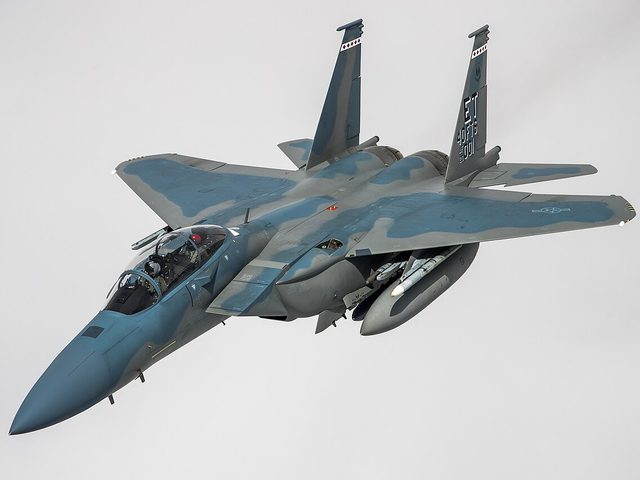
Boeing-Mcdonnell Douglas Boeing F-15 Eagle
Twin Jet· 249 globally registered
The McDonnell Douglas F-15 Eagle stands as one of the most successful air superiority fighters ever built, maintaining an undefeated combat record with over 100 aerial victories and zero losses in air-to-air combat across multiple conflicts since its introduction in 1976. Designed in response to the perceived threat of advanced Soviet fighters in the late 1960s, the F-15 was purpose-built around the mantra of air dominance, combining exceptional thrust-to-weight ratio, advanced radar, and unmatched maneuverability. Its twin Pratt & Whitney F100 turbofans deliver enough power to accelerate vertically from a standing start, and the aircraft can sustain Mach 2.5 at altitude while retaining energy in turning engagements that would bleed speed from lesser designs. The Eagle's combat debut came with the Israeli Air Force in 1979, and U.S. Air Force F-15Cs dominated Iraqi skies during Desert Storm, cementing the type's reputation. Variants include the original single-seat F-15A/C air superiority models, the two-seat F-15B/D trainers and strike variants, and the F-15E Strike Eagle multirole fighter-bomber that added significant ground-attack capability while retaining full air-to-air lethality. The F-15's operational ceiling exceeds 65,000 feet, and its combat radius approaches 1,200 nautical miles with external tanks. More than four decades after first flight, upgraded F-15s remain frontline fighters with the U.S. Air Force, Israeli Air Force, Royal Saudi Air Force, and Japan Air Self-Defense Force, with new-build F-15EX Advanced Eagles entering service in the 2020s featuring modern avionics, fly-by-wire controls, and expanded weapons capacity that extend the type's relevance well into mid-century.
Safety in context
The incident rate counts flights with ANY safety event detected by SkyMeter: go-arounds (a routine response, not a failure), unstable-approach gate flags (advisory thresholds), rejected takeoffs (the system working as designed), and runway events. It is NOT an accident rate or fatality rate. For accident statistics, refer to the NTSB Aviation Accident Database (USA) or the Aviation Safety Network. See methodology for what each event type measures.
Performance
Speed envelope & approach
Dimensions
Airframe geometry
Weight & identification
Operating limits
Top operators
By fleet size · last 7 days
No operator data available.
Safety profile
Flagged flights · last 7 days
No safety data available.
Family
Related variants
No related variants.
Recent incidents
Flagged flights of F15

Recent flights
Real flights of F15 · airborne ≥ 20 min


