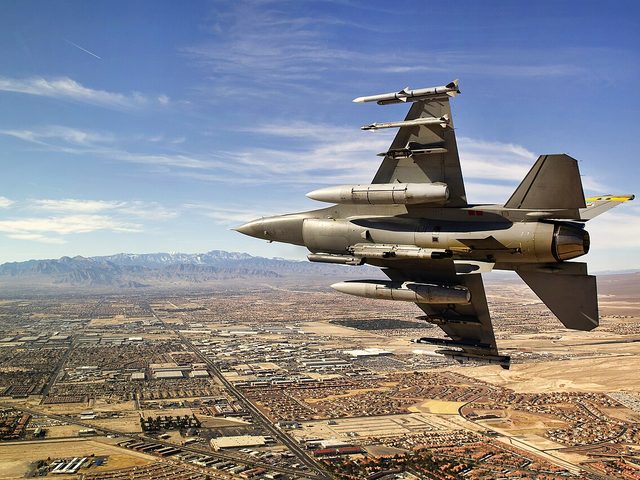
Lockheed-General Dynamics Lockheed F-16 Fighting Falcon
Single Jet· 1,017 globally registered
The General Dynamics F-16 Fighting Falcon is the world's most numerous Western fighter aircraft, with over 4,600 built since its first flight in 1974. Originally conceived as a lightweight day fighter emphasizing agility and pilot visibility, the F-16 pioneered fly-by-wire flight controls and a side-stick controller in a production fighter, enabling sustained 9G maneuvers that would be impossible with conventional control systems. Its frameless bubble canopy provides unmatched all-around visibility, while the reclined ejection seat helps pilots withstand the extreme G-forces during air combat maneuvering. The Fighting Falcon serves 25 air forces worldwide and has been continuously upgraded through multiple block configurations, evolving from a pure dogfighter into a true multirole platform capable of precision strike, suppression of enemy air defenses, and beyond-visual-range combat. The single Pratt & Whitney F100 or General Electric F110 afterburning turbofan produces 29,000 pounds of thrust, giving the F-16 a thrust-to-weight ratio exceeding 1:1 at combat weight, meaning it can accelerate while climbing vertically. Maximum speed reaches Mach 2.05 at altitude, though the aircraft's real strength lies in sustained turn performance and energy retention in the subsonic-to-transonic regime where most engagements occur. Civilian operators like Top Aces fly ex-military F-16s as adversary aircraft, providing realistic threat simulation for air forces training against fourth-generation fighter tactics. These aircraft retain full aerobatic capability and operate under FAA experimental or restricted category certificates, flying profiles that replicate hostile fighter behavior during dissimilar air combat training. SkyMeter has tracked 25 flights across 6 airframes and 1 operators, with TOP ACES CORP the largest observed operator.
Safety in context
The incident rate counts flights with ANY safety event detected by SkyMeter: go-arounds (a routine response, not a failure), unstable-approach gate flags (advisory thresholds), rejected takeoffs (the system working as designed), and runway events. It is NOT an accident rate or fatality rate. For accident statistics, refer to the NTSB Aviation Accident Database (USA) or the Aviation Safety Network. See methodology for what each event type measures.
Performance
Speed envelope & approach
Dimensions
Airframe geometry
Weight & identification
Operating limits
Top operators
By fleet size · last 7 days

Safety profile
Flagged flights · last 7 days
Family
Related variants
No related variants.
Recent incidents
Flagged flights of F16


Recent flights
Real flights of F16 · airborne ≥ 20 min

