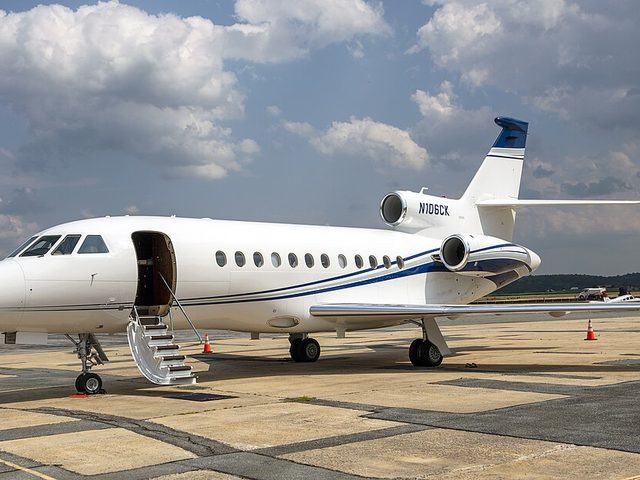
Dassault Falcon 900
Tri Jet· 386 globally registered
The Dassault Falcon 900 is a French-built long-range business jet distinguished by its three-engine configuration, a rarity in modern corporate aviation that provides exceptional safety margins and hot-and-high performance. First flown in 1984 and entering service in 1986, the Falcon 900 was Dassault's answer to intercontinental business travel, capable of nonstop flights from New York to Paris or Los Angeles to London with eight passengers in stand-up-cabin comfort. Its trijet layout, inherited from the smaller Falcon 50, allows the aircraft to maintain cruise performance even with an engine failure and meets stringent ETOPS-like dispatch reliability without the regulatory complexity, making it popular for overwater and remote operations. Powered by three Honeywell TFE731 turbofans, the Falcon 900 cruises at Mach 0.84 and reaches a maximum altitude of 51,000 feet, placing it among the highest-flying business jets of its era. The type's range of approximately 4,000 nautical miles in the original variant extended to over 4,750 nm in the later 900EX and 5,950 nm in the 900LX, cementing its reputation as a true intercontinental performer. The wing design, featuring Dassault's signature low-speed handling characteristics, delivers a relatively low approach speed of around 120 knots and short-field capability uncommon in jets of this size and range. The Falcon 900 family has seen continuous evolution through the 900B, 900EX, 900DX, and 900LX variants, each bringing improved engines, avionics, and range. While production has slowed in favor of newer Dassault models, the type remains a fixture in corporate and charter fleets worldwide, prized for its blend of range, cabin comfort, and operational flexibility. SkyMeter has tracked 1,015 flights across 269 airframes and 183 operators over routes, with TVPX AIRCRAFT SOLUTIONS INC TRUSTEE the largest observed operator.
Safety in context
The incident rate counts flights with ANY safety event detected by SkyMeter: go-arounds (a routine response, not a failure), unstable-approach gate flags (advisory thresholds), rejected takeoffs (the system working as designed), and runway events. It is NOT an accident rate or fatality rate. For accident statistics, refer to the NTSB Aviation Accident Database (USA) or the Aviation Safety Network. See methodology for what each event type measures.
Performance
Speed envelope & approach
Dimensions
Airframe geometry
Weight & identification
Operating limits
Top operators
By fleet size · last 7 days


Safety profile
Flagged flights · last 7 days
Family
Related variants
No related variants.
Recent incidents
Flagged flights of F900


Recent flights
Real flights of F900 · airborne ≥ 20 min


