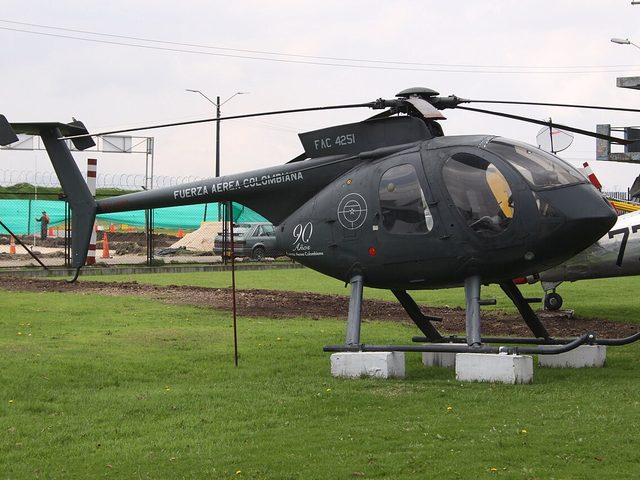
Md Helicopters Md500
Single Turboshaft
The MD 500 is a light single-engine helicopter descended from the Hughes 369, a design that first flew in 1963 and became one of the most successful light turbine helicopters ever built. Originally developed by Hughes Helicopters and later produced by McDonnell Douglas and MD Helicopters, the 500 series is known for its compact size, agility, and distinctive egg-shaped fuselage. Its military sibling, the OH-6 Cayuse, earned fame as the "Loach" during the Vietnam War, flying low-level reconnaissance missions, but the civilian MD 500 found its niche in law enforcement, emergency medical services, executive transport, and tourism operations worldwide. The type's appeal lies in its versatility and operating economics. Powered by a single Allison 250-series turboshaft engine producing around 420 shaft horsepower, the MD 500 can carry four to five occupants depending on configuration, with a useful load of roughly 1,400 pounds. Its cruise speed hovers around 130 knots, and it can operate comfortably at altitudes up to 10,000 feet, making it suitable for mountain operations and urban environments alike. The helicopter's small footprint and excellent visibility make it a favorite for police air support units, where its ability to loiter quietly and maneuver in tight spaces proves invaluable. Tour operators prize it for doors-off scenic flights, while EMS providers appreciate its speed and cabin access for medical crews. Over six decades of continuous production have resulted in thousands of MD 500s delivered globally, with variants ranging from the original 500C to the modern 500E and 530F models featuring more powerful engines and upgraded avionics. The type remains in production today, a testament to the enduring soundness of the original Hughes design. Its combination of reliability, maintainability, and performance has kept it competitive against newer light singles, and its proven track record ensures it remains a common sight at heliports and helipads across North America and beyond. SkyMeter has tracked 703 flights across 218 airframes and 125 operators, with BANK OF UTAH TRUSTEE the largest observed operator.
Safety in context
The incident rate counts flights with ANY safety event detected by SkyMeter: go-arounds (a routine response, not a failure), unstable-approach gate flags (advisory thresholds), rejected takeoffs (the system working as designed), and runway events. It is NOT an accident rate or fatality rate. For accident statistics, refer to the NTSB Aviation Accident Database (USA) or the Aviation Safety Network. See methodology for what each event type measures.
Performance
Speed envelope & approach
Dimensions
Airframe geometry
Weight & identification
Operating limits
Top operators
By fleet size · last 7 days


Safety profile
Flagged flights · last 7 days
Family
Related variants
No related variants.
Recent flights
Real flights of H500 · airborne ≥ 20 min


