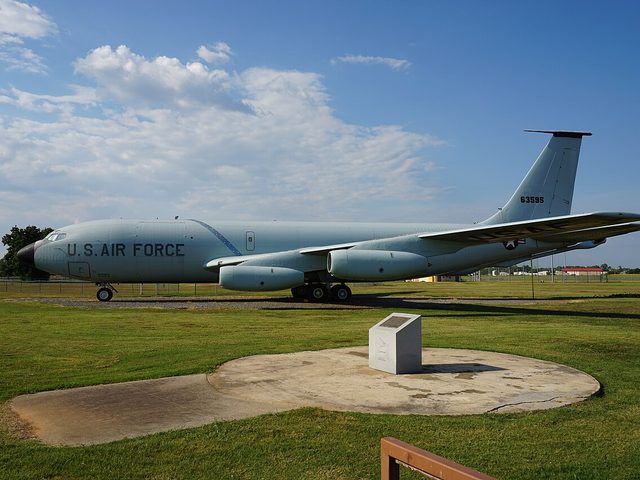
Boeing Kc-135 Stratotanker
Quad Jet· 4 globally registered
The Boeing KC-135R Stratotanker is the backbone of American aerial refueling, a Cold War-era tanker that has kept U.S. and allied combat aircraft aloft for more than six decades. Derived from the Boeing 367-80 prototype that also spawned the 707 airliner, the KC-135 entered service in 1957 as the world's first jet-powered tanker, replacing piston-engine KB-29s and KB-50s. The R-model designation marks the most significant upgrade in the type's history: between 1984 and 2002, the Air Force re-engined 415 airframes with CFM International CFM56 turbofans, replacing the original Pratt & Whitney J57 turbojets. The new engines delivered 24 percent more thrust, cut fuel consumption by 25 percent, and dramatically reduced noise, transforming a 1950s design into an aircraft expected to serve into the 2040s. The KC-135R can offload roughly 200,000 pounds of fuel on a typical mission, operating from a service ceiling above 50,000 feet with a range exceeding 1,500 nautical miles when fully loaded. Its flying boom system transfers fuel at up to 1,000 gallons per minute, far faster than the probe-and-drogue rigs used by most other tankers. The Stratotanker has supported every major U.S. military operation since Vietnam, from Desert Storm to enduring campaigns in Afghanistan and the Middle East, often flying 20-hour sorties with multiple receiver aircraft. Beyond the U.S. Air Force, France, Singapore, Turkey, and Chile operate KC-135 variants, and a small number have entered civilian hands for cargo and specialized transport roles. SkyMeter has tracked 45 flights across 29 airframes and 2 operators, with WILMINGTON TRUST CO TRUSTEE the largest observed operator.
Safety in context
The incident rate counts flights with ANY safety event detected by SkyMeter: go-arounds (a routine response, not a failure), unstable-approach gate flags (advisory thresholds), rejected takeoffs (the system working as designed), and runway events. It is NOT an accident rate or fatality rate. For accident statistics, refer to the NTSB Aviation Accident Database (USA) or the Aviation Safety Network. See methodology for what each event type measures.
Performance
Speed envelope & approach
Dimensions
Airframe geometry
Weight & identification
Operating limits
Top operators
By fleet size · last 7 days

Safety profile
Flagged flights · last 7 days
Family
Related variants
No related variants.
Recent incidents
Flagged flights of K35R


Recent flights
Real flights of K35R · airborne ≥ 20 min


