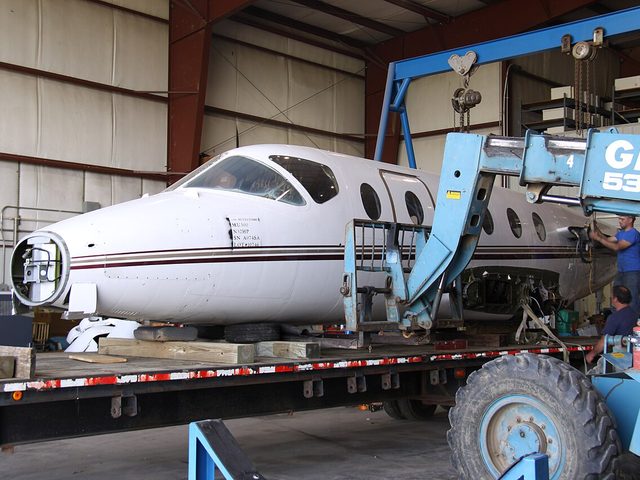
Mitsubishi Diamond/Mu300 Diamond
Twin Jet· 29 globally registered
The Mitsubishi MU-300 Diamond represents one of aviation's more interesting corporate lineages: a Japanese-designed light business jet that became an American icon under Beechcraft ownership. First flown in 1978, the MU-300 was Mitsubishi Heavy Industries' entry into the competitive light jet market, featuring a distinctive T-tail, swept wings, and twin Pratt & Whitney JT15D turbofans mounted on the aft fuselage. The aircraft seated six to eight passengers and offered transcontinental range with a cruise speed around 460 knots, making it a capable alternative to the Learjet 35 and Citation II. Beechcraft acquired the type certificate in 1985, renaming it the Beechjet 400 and later refining it into the 400A with improved avionics and interior appointments. The design proved remarkably durable. Hawker Beechcraft continued production through 2013 as the Hawker 400XP, making it one of the longest-running light jet programs in history. The type found favor with corporate flight departments, air charter operators, and the U.S. military, which operates a variant as the T-1A Jayhawk for pilot training. Its relatively low operating costs and solid construction earned it a reputation as a workhorse in the light jet category. The MU-300's operating envelope includes a service ceiling of 43,000 feet and a maximum range of approximately 1,400 nautical miles with reserves. Its approach speed of around 110 knots and short-field capability made it suitable for smaller airports often inaccessible to larger business jets. While not the fastest or most spacious in its class, the Diamond's reliability and straightforward systems contributed to its three-decade production run, a rare achievement in business aviation. SkyMeter has tracked 16 flights across 1 airframes and 1 operators, with MIKE MOSER INC the largest observed operator.
Safety in context
The incident rate counts flights with ANY safety event detected by SkyMeter: go-arounds (a routine response, not a failure), unstable-approach gate flags (advisory thresholds), rejected takeoffs (the system working as designed), and runway events. It is NOT an accident rate or fatality rate. For accident statistics, refer to the NTSB Aviation Accident Database (USA) or the Aviation Safety Network. See methodology for what each event type measures.
Performance
Speed envelope & approach
Dimensions
Airframe geometry
Weight & identification
Operating limits
Top operators
By fleet size · last 7 days

Safety profile
Flagged flights · last 7 days
Family
Related variants
No related variants.
Recent incidents
Flagged flights of MU30
Recent flights
Real flights of MU30 · airborne ≥ 20 min
