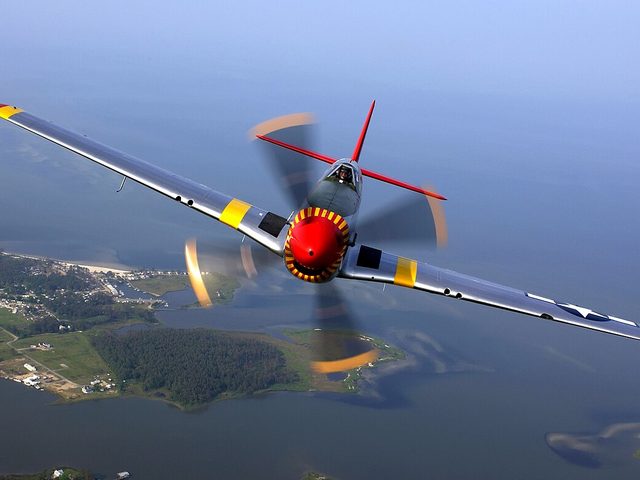
North American Mustang
Single Piston· 150 globally registered
The North American P-51 Mustang is widely regarded as the finest piston-engine fighter of World War II and the aircraft that gave the Allies air superiority over Europe. Designed in 1940 and first flown in October that year, the Mustang achieved legendary status after being paired with the Rolls-Royce Merlin engine in 1942, transforming it from a capable low-altitude fighter into a high-altitude escort with unprecedented range. The P-51D variant, with its bubble canopy and six .50-caliber machine guns, became the definitive model and remains the most common survivor in airworthy condition today. What set the Mustang apart was its laminar-flow wing and exceptional fuel efficiency, enabling it to escort B-17 and B-24 bombers all the way to Berlin and back, a 1,500-mile round trip no other Allied fighter could match in 1944. Powered by the Packard V-1650 Merlin producing 1,490 horsepower, the P-51D could reach 437 mph at 25,000 feet and operate at altitudes exceeding 41,000 feet. Its combination of speed, range, maneuverability, and firepower made it the dominant air-superiority fighter of the European theater, credited with destroying more enemy aircraft than any other USAF fighter in that campaign. Nearly 15,000 Mustangs were built between 1940 and 1945, serving not only with the USAF but also the RAF, RAAF, and numerous other air forces well into the 1980s. Today, several hundred P-51s survive, with approximately 150 airworthy examples making it one of the most active warbird types at airshows worldwide. The type remains prized for its handling qualities, distinctive Merlin growl, and historical significance as the aircraft that helped win the air war over Nazi Germany. SkyMeter has tracked 36 flights across 21 airframes and 21 operators, with BENZING VICTORIA S the largest observed operator.
Safety in context
The incident rate counts flights with ANY safety event detected by SkyMeter: go-arounds (a routine response, not a failure), unstable-approach gate flags (advisory thresholds), rejected takeoffs (the system working as designed), and runway events. It is NOT an accident rate or fatality rate. For accident statistics, refer to the NTSB Aviation Accident Database (USA) or the Aviation Safety Network. See methodology for what each event type measures.
Performance
Speed envelope & approach
Dimensions
Airframe geometry
Weight & identification
Operating limits
Top operators
By fleet size · last 7 days


Safety profile
Flagged flights · last 7 days
Family
Related variants
No related variants.
Recent incidents
Flagged flights of P51


Recent flights
Real flights of P51 · airborne ≥ 20 min