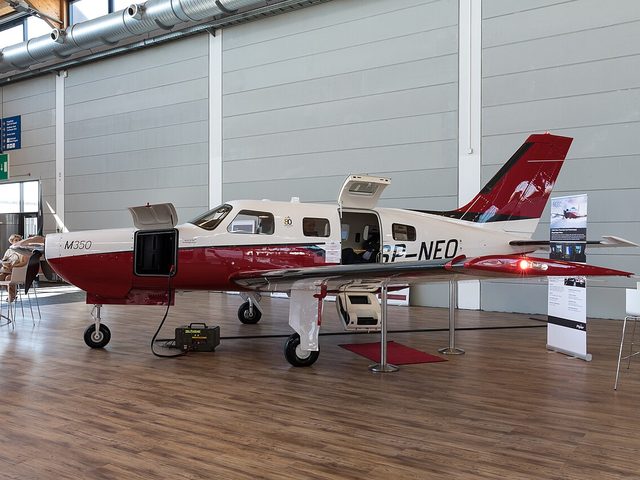
Piper Malibu
Single Piston· 222 globally registered
The Piper PA-46 represents one of general aviation's most ambitious attempts to bring cabin-class comfort and high-altitude capability to the owner-flown single-engine market. Introduced in 1984 as the Malibu, it was the first pressurized single-engine piston aircraft certified for civilian use, offering a 25,000-foot service ceiling and 200-knot cruise speeds that rivaled light twins while burning less fuel. The design married a Continental TSIO-520 engine to a sleek, low-wing airframe with seating for six and enough range to make transcontinental flights practical for well-heeled private owners. Piper refined the line over four decades, introducing the Lycoming-powered Mirage in 1989 with improved climb performance and the unpressurized Matrix in 2007 as a lower-cost variant. The PA-46 became a staple of serious cross-country flying, popular with doctors, business owners, and step-up buyers leaving high-performance singles like the Bonanza or Cirrus behind. Its pressurized cabin and oxygen system allow comfortable flight above most weather, though the combination of a single piston engine, complex systems, and high-altitude operations demands proficiency and respect—the type has a higher-than-average accident rate among owner-flown aircraft, often linked to loss of control in IMC or mismanagement of the pressurization and turbocharging systems. The PA-46 designation also covers the turboprop Meridian (introduced 2000) and its successors, the M500 and M600, which share the same airframe but swap the piston engine for a Pratt & Whitney PT6A turbine. These variants cruise faster, climb better, and simplify operations, though they fall into a different performance and price class. The piston Malibu and Mirage remain in production and continue to attract pilots seeking the most capable single-engine piston aircraft money can buy, balancing speed, range, and comfort in a package that still fits in a standard T-hangar. SkyMeter has tracked 965 flights across 378 airframes and 303 operators, spanning unique routes, with CANADA RONALD G the most frequently observed operator.
Safety in context
The incident rate counts flights with ANY safety event detected by SkyMeter — go-arounds (a routine response, not a failure), unstable-approach gate flags (advisory thresholds), rejected takeoffs (the system working as designed), and runway events. It is NOT an accident rate or fatality rate. For accident statistics, refer to the NTSB Aviation Accident Database (USA) or the Aviation Safety Network. See methodology for what each event type measures.
Performance
Speed envelope & approach
Dimensions
Airframe geometry
Weight & identification
Operating limits
Top operators
By fleet size · last 7 days


Safety profile
Flagged flights · last 7 days
Family
Related variants
Recent incidents
Flagged flights of PA46


Recent flights
Real flights of PA46 · airborne ≥ 20 min


