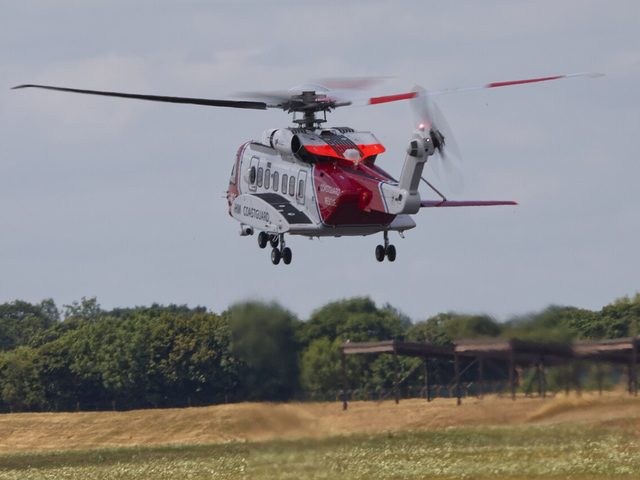
Sikorsky S-92a
Twin Turboshaft
The Sikorsky S-92 is a twin-engine medium-lift helicopter designed for offshore oil and gas transport, search and rescue, and VIP operations. First flown in 1998 and certified in 2002, it was developed as Sikorsky's successor to the venerable S-61 Sea King, incorporating modern fly-by-wire controls, composite rotor blades, and a spacious 19-passenger cabin. The S-92 quickly became the dominant platform for North Sea and North Atlantic offshore crew changes, prized for its range (up to 620 nautical miles), all-weather capability, and dual-engine redundancy over water. The type's safety record and operational flexibility have made it a global standard for demanding maritime missions. Bristow Group, CHC Helicopter, and other major operators fly S-92s on long-range offshore routes where reliability is non-negotiable. The helicopter's four-axis autopilot and advanced avionics reduce pilot workload in poor visibility and icing conditions common over cold seas. Maximum cruise speed reaches 165 knots, and service ceiling extends to 15,000 feet, though most offshore sorties operate below 2,000 feet. The S-92's main rotor system and gearbox are designed for a 30-minute run-dry capability, allowing continued flight even after catastrophic oil loss. Military variants include the VH-92A Patriot, which replaced the aging VH-3 Sea King as the U.S. presidential helicopter (Marine One) starting in 2020, and the CH-148 Cyclone flown by the Royal Canadian Air Force for shipboard maritime patrol. Commercial operators have logged millions of flight hours, particularly in the North Sea, Gulf of Mexico, and offshore Brazil, where the S-92's combination of payload, range, and twin-engine safety margin remains unmatched in its class. SkyMeter has tracked 760 flights across 96 airframes and 16 operators, with Cougar Helicopters Inc. the largest observed operator.
Safety in context
The incident rate counts flights with ANY safety event detected by SkyMeter: go-arounds (a routine response, not a failure), unstable-approach gate flags (advisory thresholds), rejected takeoffs (the system working as designed), and runway events. It is NOT an accident rate or fatality rate. For accident statistics, refer to the NTSB Aviation Accident Database (USA) or the Aviation Safety Network. See methodology for what each event type measures.
Performance
Speed envelope & approach
Dimensions
Airframe geometry
Weight & identification
Operating limits
Top operators
By fleet size · last 7 days


Safety profile
Flagged flights · last 7 days
Family
Related variants
No related variants.
Recent flights
Real flights of S92 · airborne ≥ 20 min


