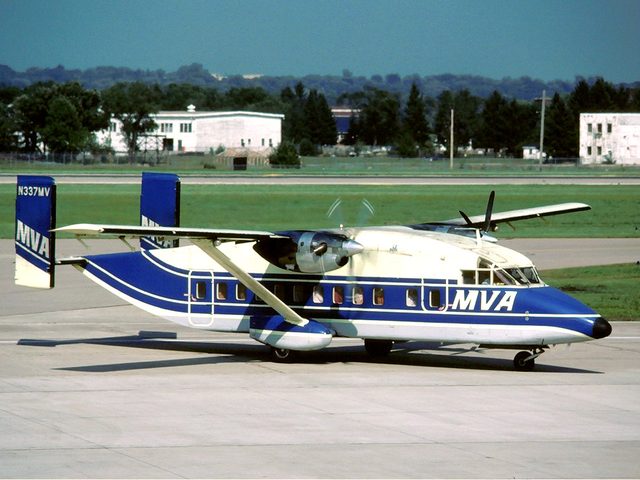
Shorts 330
Twin Turboprop· 16 globally registered
The Short SD3-30 Sherpa is a rugged twin-turboprop freighter derived from the Short 330 commuter airliner, purpose-built for cargo operations in challenging environments. Developed by Short Brothers of Belfast in the early 1980s, the Sherpa features a squared fuselage cross-section optimized for palletized freight, a rear loading ramp for rapid turnaround, and rugged landing gear designed for unpaved strips. Powered by two Pratt & Whitney Canada PT6A-45R turboprops producing 1,198 shaft horsepower each, the aircraft can haul up to 7,000 pounds of cargo over 750 nautical miles, making it a workhorse for express freight, military logistics, and remote resupply missions. The Sherpa earned its reputation operating in austere conditions where larger freighters cannot venture. Its high wing and fixed tricycle gear provide excellent ground clearance, while the unpressurized cabin simplifies maintenance and allows operations from rough fields at elevations up to 10,000 feet. The United States Army and Air National Guard operated military variants (C-23 Sherpa) for decades, moving priority cargo and personnel to forward operating bases. In civilian service, the type found a niche with overnight express carriers and charter operators serving oil fields, mining camps, and island communities where reliability trumps speed. With a maximum operating speed of 222 knots and a service ceiling of 10,000 feet, the Sherpa is deliberately slow and low compared to pressurized turboprops, but its ability to land on 2,000-foot gravel strips and carry outsized cargo through the rear ramp makes it irreplaceable in specialized roles. The boxy fuselage and fixed gear create significant drag, limiting cruise speed to around 180 knots, but operators prize the aircraft's simplicity, low operating costs, and go-anywhere capability. Production ended in the late 1980s after fewer than 50 Sherpas were built, but the type remains active in niche cargo operations where its unique combination of payload capacity, short-field performance, and rear-loading convenience still delivers value. SkyMeter has tracked flights across airframes and operators over routes, with the largest observed operator.
Safety in context
The incident rate counts flights with ANY safety event detected by SkyMeter: go-arounds (a routine response, not a failure), unstable-approach gate flags (advisory thresholds), rejected takeoffs (the system working as designed), and runway events. It is NOT an accident rate or fatality rate. For accident statistics, refer to the NTSB Aviation Accident Database (USA) or the Aviation Safety Network. See methodology for what each event type measures.
Performance
Speed envelope & approach
Dimensions
Airframe geometry
Weight & identification
Operating limits
Top operators
By fleet size · last 7 days
No operator data available.
Safety profile
Flagged flights · last 7 days
No safety data available.
Family
Related variants
Recent incidents
Flagged flights of SH33


Recent flights
Real flights of SH33 · airborne ≥ 20 min

