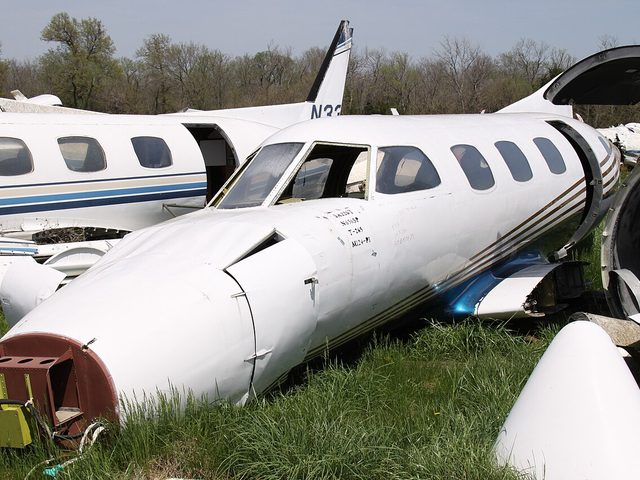
Fairchild Swearingen Sa-226t/Tb Merlin 3
Twin Turboprop· 56 globally registered
The Fairchild Metro III (SA227-AC) is a pressurized twin-turboprop commuter aircraft that became the workhorse of regional airlines and cargo operators from the early 1980s onward. Built by Fairchild Aircraft (later Fairchild Dornier), the Metro III evolved from the earlier Swearingen Metroliner series and introduced more powerful Garrett TPE331-11 engines, improved systems, and a distinctive T-tail configuration. With seating for 19 passengers in airline service, the Metro III carved out a niche as a rugged, reliable short-haul transport capable of operating from shorter runways and in challenging weather conditions that grounded many competitors. Its unpressurized cargo variant, the Expediter, became equally popular for freight and express parcel operations. The Metro III's operating envelope reflects its commuter mission: a maximum cruise speed around 290 knots, service ceiling of 25,000 feet, and range of approximately 1,000 nautical miles with full payload. While not glamorous, the type earned a reputation for dispatch reliability and low operating costs, making it a favorite among regional carriers throughout North America, Australia, and parts of Europe during the 1980s and 1990s. The aircraft's relatively high approach speed (around 110 knots) and spirited handling characteristics demanded proficient crew skills, contributing to its professional mystique among turboprop pilots. Today, the Metro III has largely retired from scheduled passenger service, replaced by newer regional jets and turboprops, but it remains active in cargo, charter, medical evacuation, and specialized roles where its combination of speed, payload, and short-field performance still proves valuable. SkyMeter has tracked 107 flights across 24 airframes and 23 operators over routes, with EV ADVISORS LLC (N11) the largest observed operator.
Safety in context
The incident rate counts flights with ANY safety event detected by SkyMeter: go-arounds (a routine response, not a failure), unstable-approach gate flags (advisory thresholds), rejected takeoffs (the system working as designed), and runway events. It is NOT an accident rate or fatality rate. For accident statistics, refer to the NTSB Aviation Accident Database (USA) or the Aviation Safety Network. See methodology for what each event type measures.
Performance
Speed envelope & approach
Dimensions
Airframe geometry
Weight & identification
Operating limits
Top operators
By fleet size · last 7 days


Safety profile
Flagged flights · last 7 days
Family
Related variants
No related variants.
Recent incidents
Flagged flights of SW3
Recent flights
Real flights of SW3 · airborne ≥ 20 min

