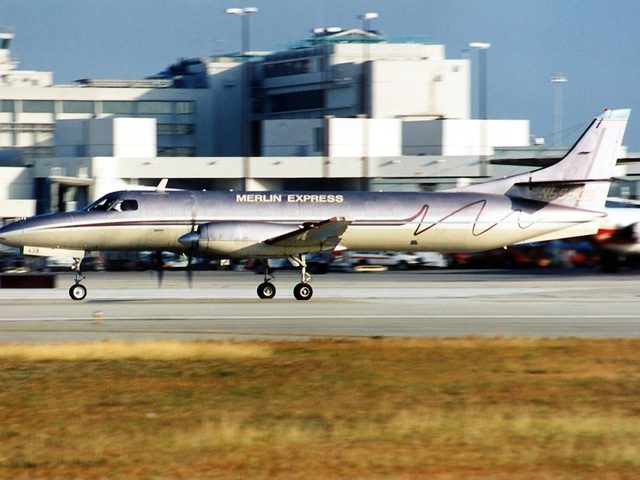
Fairchild Swearingen Swearingen Sa-227at Merlin 4
Twin Turboprop· 28 globally registered
The Fairchild Swearingen Metro is a 19-seat pressurized twin-turboprop commuter aircraft that became the workhorse of regional aviation across North America and beyond from the 1970s through the 2000s. Developed from the earlier Merlin business aircraft, the Metro combined a stand-up cabin, reliable Garrett TPE331 engines, and the ability to operate from short runways, making it ideal for connecting small communities to hub airports. Over 1,000 Metros were built across multiple variants, with the Metro III (SA227-AC) and Metro 23 (SA227-DC) becoming the most common models in airline service. The Metro's long, slender fuselage and distinctive T-tail gave it excellent high-altitude performance for its class, with a service ceiling of 25,000 feet and cruising speeds around 260 knots. Its rugged landing gear and powerful engines allowed operations into gravel strips and high-elevation airports that larger regional jets couldn't serve economically. While newer turboprops like the Dash 8 and ATR eventually displaced it from major carriers, the Metro found a second life in cargo operations, air ambulance roles, and serving remote routes in Canada, Australia, and Alaska. Today the Metro remains in active service primarily with smaller regional carriers and charter operators who value its reliability, low operating costs, and ability to handle challenging airfields. The type earned a reputation for being demanding to fly: pilots noted its narrow fuselage, limited autopilot capabilities in early models, and tendency toward Dutch roll, but also respected its performance and dispatch reliability in harsh conditions. SkyMeter has tracked 724 flights across 113 airframes and 28 operators, with PERIMETER AVIATION LP AS REPRESENTED BY ITS GENERAL PARTNER, PER the largest observed operator.
Safety in context
The incident rate counts flights with ANY safety event detected by SkyMeter: go-arounds (a routine response, not a failure), unstable-approach gate flags (advisory thresholds), rejected takeoffs (the system working as designed), and runway events. It is NOT an accident rate or fatality rate. For accident statistics, refer to the NTSB Aviation Accident Database (USA) or the Aviation Safety Network. See methodology for what each event type measures.
Performance
Speed envelope & approach
Dimensions
Airframe geometry
Weight & identification
Operating limits
Top operators
By fleet size · last 7 days


Safety profile
Flagged flights · last 7 days
Family
Related variants
No related variants.
Recent incidents
Flagged flights of SW4

Recent flights
Real flights of SW4 · airborne ≥ 20 min


