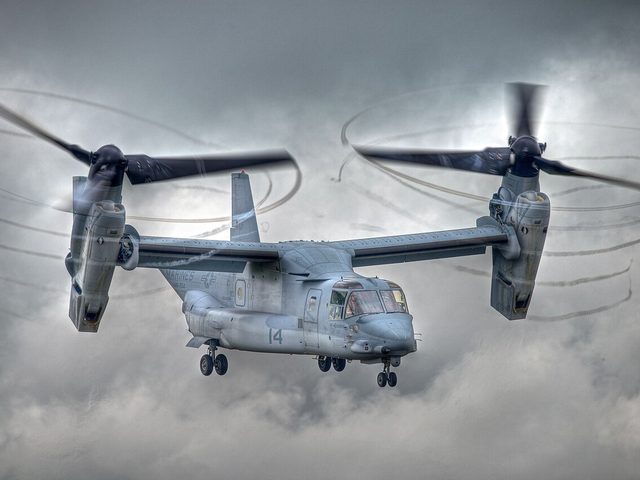
Bell-Boeing Bell V-22 Osprey
Twin Turboshaft· 400 globally registered
The Bell Boeing V-22 Osprey is the world's first production tiltrotor aircraft to enter operational military service, combining the vertical takeoff and hover capability of a helicopter with the speed and range of a fixed-wing turboprop. Developed jointly by Bell Helicopter and Boeing through a tortuous three-decade program that began in the 1980s, the V-22 achieved initial operating capability with the U.S. Marine Corps in 2007 and has since been adopted by the Air Force, Navy, and Japan Ground Self-Defense Force. Its twin Rolls-Royce AE 1107C turboshaft engines drive 38-foot proprotors that rotate ninety degrees between helicopter and airplane modes, enabling the Osprey to cruise at 275 knots (nearly twice the speed of the CH-46 Sea Knight it replaced) while retaining the ability to land on ships, in confined zones, and at unprepared sites. The V-22 can carry twenty-four combat troops or up to 20,000 pounds of internal cargo across a combat radius exceeding 430 nautical miles, a transformational capability for amphibious assault and special operations that no conventional helicopter can match. Its operational envelope spans sea level to 25,000 feet, with a service ceiling that allows overflying most small-arms threats in forward areas. The type has seen extensive combat deployment in Iraq, Afghanistan, Syria, and Africa, proving the tiltrotor concept under the harshest conditions despite early developmental setbacks and accidents that plagued its testing phase. SkyMeter has tracked 168 flights across 87 airframes and 1 operators, with distinct routes observed.
Safety in context
The incident rate counts flights with ANY safety event detected by SkyMeter: go-arounds (a routine response, not a failure), unstable-approach gate flags (advisory thresholds), rejected takeoffs (the system working as designed), and runway events. It is NOT an accident rate or fatality rate. For accident statistics, refer to the NTSB Aviation Accident Database (USA) or the Aviation Safety Network. See methodology for what each event type measures.
Performance
Speed envelope & approach
Dimensions
Airframe geometry
Weight & identification
Operating limits
Top operators
By fleet size · last 7 days
No operator data available.
Safety profile
Flagged flights · last 7 days
Family
Related variants
No related variants.
Recent flights
Real flights of V22 · airborne ≥ 20 min


