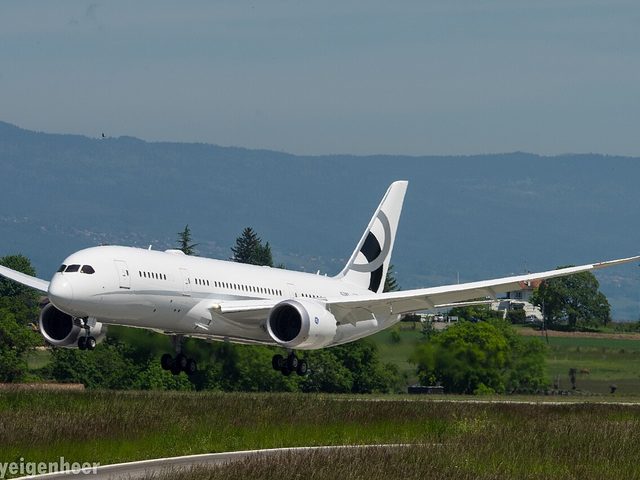
Boeing 787-8 Bbj/Dreamliner
Twin Jet· 69 globally registered
The Boeing 787-8 Dreamliner represents the first clean-sheet widebody airliner design of the 21st century and the first large commercial aircraft with a composite primary structure: more than 50 percent carbon fiber reinforced plastic by weight. Launched in 2004 and entering service with All Nippon Airways in 2011 after a protracted development, the 787-8 introduced revolutionary technologies including electrically powered systems replacing traditional pneumatic and hydraulic architectures, larger windows with electrochromic dimming, and a cabin pressurized to 6,000 feet equivalent altitude rather than the industry-standard 8,000 feet. These innovations deliver a 20 percent improvement in fuel efficiency compared to the 767 it was designed to replace, enabling ultra-long-haul point-to-point routes that were previously uneconomical. Powered by either General Electric GEnx or Rolls-Royce Trent 1000 engines, the 787-8 seats 242 passengers in a typical two-class configuration and has a maximum range of 7,355 nautical miles, sufficient for nonstop flights like Perth to London. The type cruises at Mach 0.85, matching the speed of larger widebodies while burning significantly less fuel per seat-mile. Its composite fuselage is manufactured in large barrel sections by international partners and shipped to Boeing's Everett facility for final assembly, a supply chain model that proved both innovative and initially problematic during the aircraft's troubled development phase. The 787-8 competes directly with the Airbus A330-800 and smaller A350-900 variants in the mid-size widebody market. While the stretched 787-9 and 787-10 variants have since captured larger market shares, the -8 remains popular with carriers operating thinner long-haul routes where its smaller capacity and exceptional range are ideal. The Dreamliner family has fundamentally reshaped airline network planning by making direct secondary-city pairs economically viable, bypassing traditional hub-and-spoke constraints that dominated widebody operations for decades. SkyMeter has tracked 4,737 flights across 338 airframes and 11 operators over routes, with WILMINGTON TRUST CO TRUSTEE (AVA) the largest observed operator.
Safety in context
The incident rate counts flights with ANY safety event detected by SkyMeter: go-arounds (a routine response, not a failure), unstable-approach gate flags (advisory thresholds), rejected takeoffs (the system working as designed), and runway events. It is NOT an accident rate or fatality rate. For accident statistics, refer to the NTSB Aviation Accident Database (USA) or the Aviation Safety Network. See methodology for what each event type measures.
Performance
Speed envelope & approach
Dimensions
Airframe geometry
Weight & identification
Operating limits
Top operators
By fleet size · last 7 days


Safety profile
Flagged flights · last 7 days
Family
Related variants
Recent incidents
Flagged flights of B788


Recent flights
Real flights of B788 · airborne ≥ 20 min


