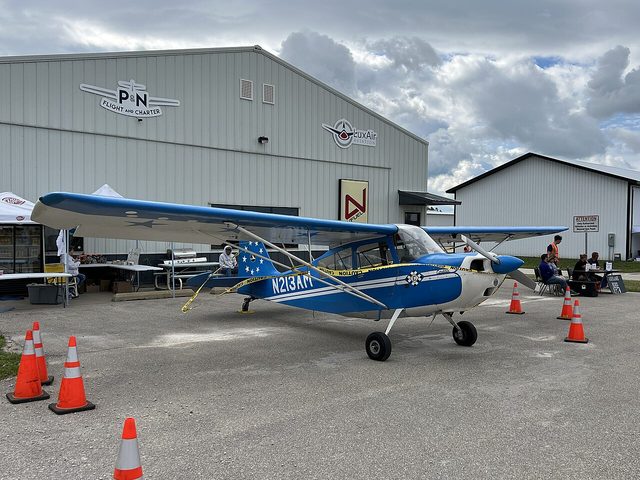
Bellanca 7gcbc Citabria
Single Piston· 478 globally registered
The Aviat Husky is a rugged two-seat taildragger purpose-built for backcountry flying, where short unimproved strips, mountain terrain, and demanding off-airport operations are the norm. Introduced in 1987 by Christen Industries and later produced by Aviat Aircraft in Afton, Wyoming, the Husky evolved from the Piper Super Cub concept but with a steel-tube fuselage, composite cowling, and modern systems. The A-1C-180 variant pairs a 180-horsepower Lycoming O-360 with a constant-speed propeller, delivering exceptional short-field performance and a useful load around 850 pounds: enough for two adults, camping gear, and fuel for remote exploration. What sets the Husky apart is its combination of rugged construction and genuine STOL capability. With a stall speed below 45 knots and oversized tires as standard, it routinely operates from gravel bars, tundra, and mountain ridges where few certificated aircraft dare venture. The tandem seating provides excellent visibility for both occupants, critical when scouting landing zones or navigating tight valleys. Large Fowler flaps and responsive controls make it forgiving at slow speeds, while the airframe tolerates the punishment of rough-field landings season after season. Pilots prize the Husky for Alaska bush flying, backcountry recreation, pipeline and powerline patrol, and wildlife survey work where access trumps speed. The type remains in production today, with Aviat offering multiple engine options and a range of factory customizations for mission-specific roles. Its reputation for reliability and capability has made it a fixture at backcountry fly-ins and a trusted tool for operators who need to reach places helicopters find expensive and wheeled aircraft find impossible. SkyMeter has tracked 75 flights across 43 airframes and 40 operators, with COHEN BENJAMIN J the largest observed operator.
Safety in context
The incident rate counts flights with ANY safety event detected by SkyMeter: go-arounds (a routine response, not a failure), unstable-approach gate flags (advisory thresholds), rejected takeoffs (the system working as designed), and runway events. It is NOT an accident rate or fatality rate. For accident statistics, refer to the NTSB Aviation Accident Database (USA) or the Aviation Safety Network. See methodology for what each event type measures.
Performance
Speed envelope & approach
Dimensions
Airframe geometry
Weight & identification
Operating limits
Top operators
By fleet size · last 7 days


Safety profile
Flagged flights · last 7 days
Family
Related variants
Recent incidents
Flagged flights of CH7B


Recent flights
Real flights of CH7B · airborne ≥ 20 min


