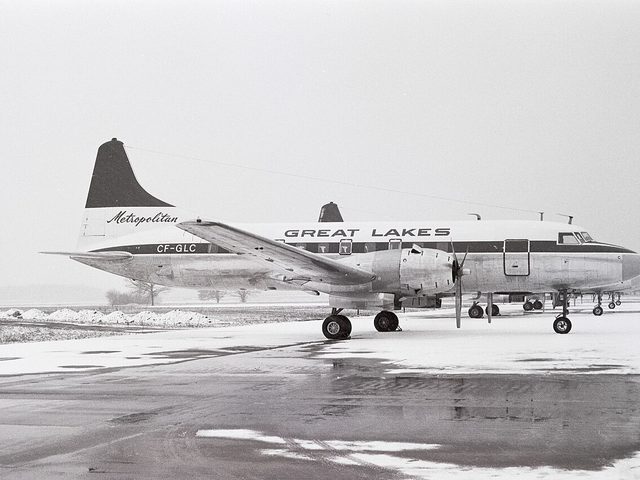
Convair Cv-440 Metropolitan
Twin Piston· 11 globally registered
The Convair 580 represents one of aviation's most successful second-life stories: a 1950s piston airliner reborn as a turboprop workhorse that outlasted its original design by decades. Beginning in 1960, hundreds of Convair 340s and 440s were retrofitted with Allison 501 turboprops, transforming fuel-thirsty piston twins into efficient regional haulers with 40% more power and dramatically lower operating costs. The conversion added roughly 50 knots to cruise speed and extended range to nearly 2,000 nautical miles, making the CV-580 a favorite of regional carriers throughout the 1960s and 70s. While passenger service largely ended by the 1990s, the type found enduring purpose in cargo operations across North America and the Caribbean. Its rugged airframe, 12,000-pound payload capacity, and ability to operate from shorter runways made it ideal for freight routes connecting island nations and remote communities. The CV-580's spacious fuselage (originally designed to seat 52 passengers in 1950s comfort) converts easily to palletized cargo, and its reliable Allison engines remain supportable through military and industrial channels. Today the Convair 580 is among the oldest turboprop designs still earning revenue, with a handful of operators maintaining small fleets for specialized cargo missions. Its operating envelope is modest by modern standards (cruise speeds around 300 knots and a service ceiling near 25,000 feet) but perfectly suited to short-haul freight where newer turboprops would be uneconomical. The type's longevity is testament to Convair's original engineering and the practicality of turboprop conversions that extended airframe life by half a century. SkyMeter has tracked 11 flights across 4 airframes and 2 operators, with IFL GROUP INC the largest observed operator.
Safety in context
The incident rate counts flights with ANY safety event detected by SkyMeter: go-arounds (a routine response, not a failure), unstable-approach gate flags (advisory thresholds), rejected takeoffs (the system working as designed), and runway events. It is NOT an accident rate or fatality rate. For accident statistics, refer to the NTSB Aviation Accident Database (USA) or the Aviation Safety Network. See methodology for what each event type measures.
Performance
Speed envelope & approach
Dimensions
Airframe geometry
Weight & identification
Operating limits
Top operators
By fleet size · last 7 days


Safety profile
Flagged flights · last 7 days
Family
Related variants
Recent incidents
Flagged flights of CVLP
Recent flights
Real flights of CVLP · airborne ≥ 20 min