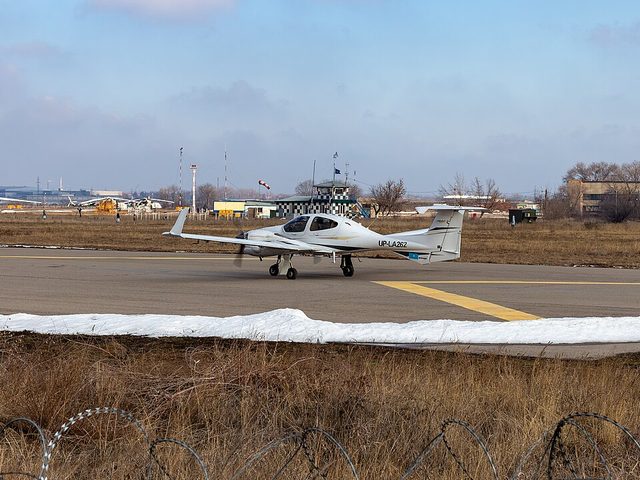
Diamond Twin Star
Twin Piston· 203 globally registered
The Diamond DA42 Twin Star stands out as the world's first diesel-powered twin-engine aircraft certified for commercial operations, entering service in 2004 from Austrian manufacturer Diamond Aircraft. Powered by two Austro Engine AE300 turbodiesels (themselves derived from Mercedes automotive blocks), the DA42 burns Jet-A fuel rather than avgas, delivering remarkable efficiency and range that redefined light twin economics. Its composite airframe, T-tail configuration, and modern glass cockpit made it an immediate favorite for flight training institutions seeking a sophisticated multi-engine platform with jet-fuel logistics and operating costs roughly 40 percent lower than legacy piston twins. The Twin Star's performance envelope reflects its training mission: a maximum cruise speed around 190 knots, service ceiling of 18,000 feet, and single-engine ceiling of 14,000 feet provide genuine multi-engine capability while remaining docile enough for ab-initio students. The aircraft's low stall speeds (59 knots landing configuration, 67 knots clean) and benign handling characteristics make it forgiving during the critical engine-out training scenarios that define the multi-engine rating syllabus. Diamond's decision to use pusher propellers and mount the engines on pylons above the wing improves both aerodynamics and cabin noise levels compared to conventional twins. Beyond training, the DA42 found roles in aerial surveillance, pipeline patrol, and light charter work where its 1,200-nautical-mile range and diesel reliability proved advantageous. The type's safety record benefits from its composite structure (which absorbs impact energy better than aluminum) and full-airframe parachute system available as an option on later variants. Universities and flight academies worldwide adopted the DA42 as their primary multi-engine trainer, valuing both its modern avionics suite and the cost predictability of diesel maintenance intervals that stretch to 2,400 hours between overhauls. SkyMeter has tracked 2,749 flights across 312 airframes and 94 operators, with EMBRY-RIDDLE AERONAUTICAL UNIVERSITY INC the largest observed operator.
Safety in context
The incident rate counts flights with ANY safety event detected by SkyMeter: go-arounds (a routine response, not a failure), unstable-approach gate flags (advisory thresholds), rejected takeoffs (the system working as designed), and runway events. It is NOT an accident rate or fatality rate. The DA42 is widely used for primary flight training, so a substantial share of flagged events are stall-recognition practice and pattern-work go-arounds. That is normal training activity, not a safety-of-flight problem. For accident statistics, refer to the NTSB Aviation Accident Database (USA) or the Aviation Safety Network. See methodology for what each event type measures.
Performance
Speed envelope & approach
Dimensions
Airframe geometry
Weight & identification
Operating limits
Top operators
By fleet size · last 7 days


Safety profile
Flagged flights · last 7 days
Family
Related variants
Recent incidents
Flagged flights of DA42

Recent flights
Real flights of DA42 · airborne ≥ 20 min


