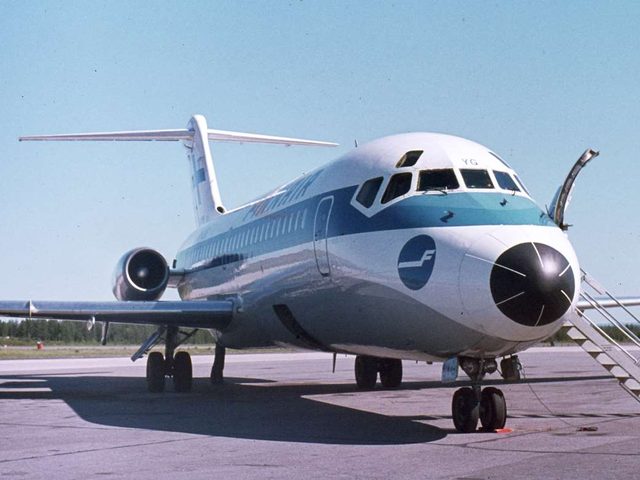
Douglas Dc 9-10
Twin Jet· 14 globally registered
The McDonnell Douglas DC-9-10 was the original short-fuselage variant of the DC-9 family, introduced in 1965 as America's answer to the BAC One-Eleven and the emerging short-haul jet market. With seating for 80-90 passengers and a fuselage length of just 104 feet, the -10 was purpose-built for high-frequency operations into smaller airports with shorter runways, featuring aft-mounted Pratt & Whitney JT8D turbofans that kept the wing clean and allowed a low-slung airframe ideal for air-stair boarding. Delta Air Lines launched the type into service in December 1965, and the design proved so successful that it spawned a family of stretched variants (-30, -40, -50) that would dominate U.S. domestic routes for three decades. The DC-9-10's performance envelope was impressive for its era: a maximum operating speed of Mach 0.84 and the ability to operate from runways as short as 4,500 feet made it a versatile workhorse for both trunk carriers and regional operators. The type's aft-mounted engines and T-tail configuration became iconic, influencing designs from the Boeing 717 to the MD-80 series. While only 137 Series 10 aircraft were built before production shifted to the longer -30 variant, the -10 established the DC-9 as one of the most successful jet transport families in history, with over 2,400 total DC-9s delivered. By the 2020s, most DC-9-10s had been retired from passenger service, but a handful remain active in cargo and charter operations, prized for their rugged simplicity and ability to access airports that modern regional jets cannot. SkyMeter has tracked 5 flights across 2 airframes and 1 operators, with SIERRA AMERICAN CORP the largest observed operator.
Safety in context
The incident rate counts flights with ANY safety event detected by SkyMeter: go-arounds (a routine response, not a failure), unstable-approach gate flags (advisory thresholds), rejected takeoffs (the system working as designed), and runway events. It is NOT an accident rate or fatality rate. For accident statistics, refer to the NTSB Aviation Accident Database (USA) or the Aviation Safety Network. See methodology for what each event type measures.
Performance
Speed envelope & approach
Dimensions
Airframe geometry
Weight & identification
Operating limits
Top operators
By fleet size · last 7 days

Safety profile
Flagged flights · last 7 days
Family
Related variants
Recent incidents
Flagged flights of DC91
Recent flights
Real flights of DC91 · airborne ≥ 20 min