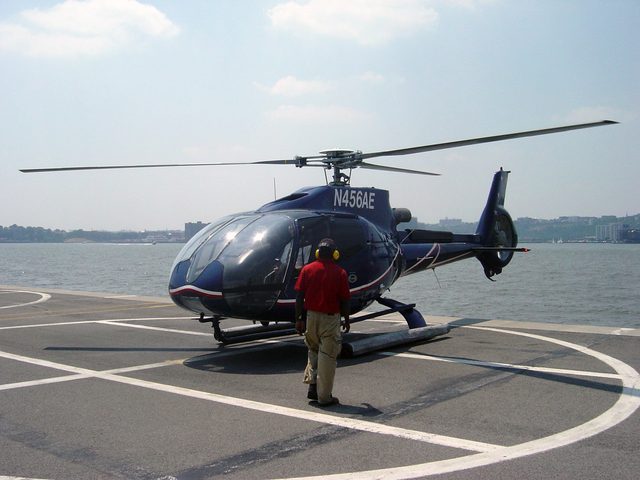
Airbus Helicopters H130/Ec130
Single Turboshaft
The Airbus Helicopters EC130 is a single-engine light utility helicopter that has become the gold standard for scenic tour operations worldwide, particularly over landmarks like the Grand Canyon, New York City, and the Great Barrier Reef. Introduced in 1999 as an evolution of the AS350 Ecureuil family, the EC130 was specifically designed with tourism in mind: its Fenestron shrouded tail rotor dramatically reduces noise (about 50% quieter than conventional tail rotors), while its wide cabin features stadium-style seating and expansive glass panels that give all passengers unobstructed views. Powered by a single Turbomeca Arriel 2B1 turboshaft engine producing 952 shaft horsepower, the EC130 can carry a pilot plus six passengers to altitudes around 23,000 feet, with a cruise speed of approximately 120 knots and a range of 370 nautical miles. Beyond tourism, the type serves in emergency medical services, law enforcement, and corporate transport roles where its combination of cabin space, low vibration, and excellent visibility make it ideal. The EC130's high-altitude performance is particularly valued in mountainous regions. It holds multiple altitude records for its class and routinely operates in the thin air of the Himalayas and Andes. Its Fenestron tail rotor also provides a significant safety advantage in confined areas and around ground personnel, as there's no exposed tail rotor arc. The type's reliability and relatively low operating costs have made it a commercial success, with over 400 delivered worldwide since its introduction. SkyMeter has tracked 968 flights across 273 airframes and 74 operators, with AIR METHODS LLC the largest observed operator.
Safety in context
The incident rate counts flights with ANY safety event detected by SkyMeter: go-arounds (a routine response, not a failure), unstable-approach gate flags (advisory thresholds), rejected takeoffs (the system working as designed), and runway events. It is NOT an accident rate or fatality rate. For accident statistics, refer to the NTSB Aviation Accident Database (USA) or the Aviation Safety Network. See methodology for what each event type measures.
Performance
Speed envelope & approach
Dimensions
Airframe geometry
Weight & identification
Operating limits
Top operators
By fleet size · last 7 days


Safety profile
Flagged flights · last 7 days
Family
Related variants
Recent flights
Real flights of EC30 · airborne ≥ 20 min


