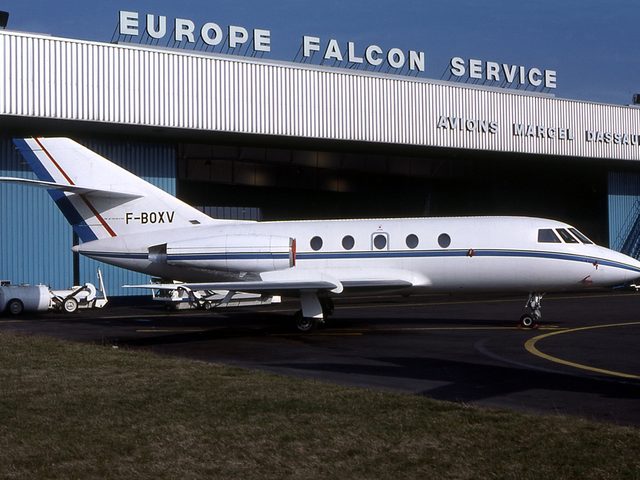
Dassault Falcon/Mystère 20
Twin Jet· 58 globally registered
The Dassault Falcon 2000 is a twin-engine business jet that brought transcontinental range and wide-cabin comfort to the super-midsize category when it entered service in 1995. Built by France's Dassault Aviation, the Falcon 2000 was designed as a smaller, more economical sibling to the three-engine Falcon 900, sharing the same fuselage cross-section but seating eight to ten passengers instead of twelve to fourteen. Its two Pratt & Whitney Canada PW308C engines deliver a maximum cruise speed of Mach 0.80 and a range of approximately 3,000 nautical miles, making it ideal for nonstop flights like New York to Los Angeles or London to Dubai. The type's combination of fuel efficiency, short-field performance, and spacious cabin quickly made it a favorite among corporate flight departments and charter operators worldwide. Beyond the executive transport role, the Falcon 2000 has found a niche in cargo and medical evacuation operations, where its reliability, range, and ability to operate from shorter runways prove invaluable. The baseline FA20 designation covers the original Falcon 2000 model, which has since spawned numerous variants including the extended-range 2000EX, the 2000LX with updated avionics, and the 2000S optimized for short runways. The aircraft's handling characteristics are praised by pilots for responsive controls and excellent crosswind capability, while its Honeywell Primus avionics suite provides modern glass-cockpit functionality. With a service ceiling of 47,000 feet, the Falcon 2000 routinely cruises above most weather and airline traffic, offering a smooth ride for passengers and efficient routing for operators. SkyMeter has tracked 208 flights across 34 airframes and 14 operators, with ROYAL AIR FREIGHT INC the largest observed operator.
Safety in context
The incident rate counts flights with ANY safety event detected by SkyMeter: go-arounds (a routine response, not a failure), unstable-approach gate flags (advisory thresholds), rejected takeoffs (the system working as designed), and runway events. It is NOT an accident rate or fatality rate. For accident statistics, refer to the NTSB Aviation Accident Database (USA) or the Aviation Safety Network. See methodology for what each event type measures.
Performance
Speed envelope & approach
Dimensions
Airframe geometry
Weight & identification
Operating limits
Top operators
By fleet size · last 7 days


Safety profile
Flagged flights · last 7 days
Family
Related variants
Recent incidents
Flagged flights of FA20


Recent flights
Real flights of FA20 · airborne ≥ 20 min
