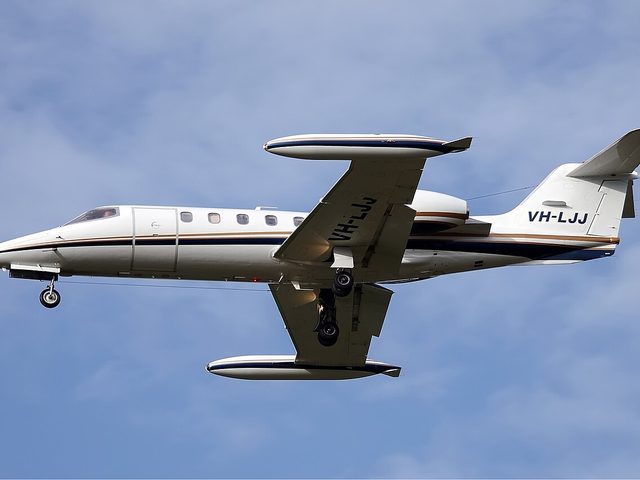
Learjet Bombardier Learjet 24
Twin Jet· 37 globally registered
The Learjet 24 is the aircraft that made Bill Lear's name synonymous with fast, glamorous business aviation. Introduced in 1966 as a stretched, more powerful evolution of the pioneering Learjet 23, the Model 24 seated six to eight passengers and could cruise at 465 knots (faster than many military jets of the era) while climbing to 45,000 feet in under ten minutes. Powered by twin General Electric CJ610 turbojets (the civilian version of the J85 that powered the T-38 Talon and F-5 Tiger), the 24 became the quintessential executive jet of the late 1960s and early 1970s, flown by corporations, air ambulance operators, and a few air forces. Its needle nose, tip tanks, and steep approach profile made it instantly recognizable on any ramp. Learjet built 259 examples of the Model 24 between 1966 and 1977, including the 24A through 24F variants with progressively refined systems and slightly higher weights. The type earned a reputation for blistering speed and a demanding flight deck: early Learjets had no flight director, primitive autopilots, and required pilots to stay ahead of an aircraft that accelerated and descended like a dart. The 24's range was modest at around 1,500 nautical miles, but for city-pair missions across the continental United States it was unmatched in speed and style. Frank Sinatra, Danny Kaye, and a host of Fortune 500 CEOs flew in Learjet 24s during the type's heyday. Today the Learjet 24 is a rare sight, with most examples retired or preserved in museums, though a handful remain active in private hands and with specialty operators. SkyMeter has tracked 3 flights across 1 airframes and 1 operators, with BUTLER NATIONAL INC the largest observed operator.
Safety in context
The incident rate counts flights with ANY safety event detected by SkyMeter: go-arounds (a routine response, not a failure), unstable-approach gate flags (advisory thresholds), rejected takeoffs (the system working as designed), and runway events. It is NOT an accident rate or fatality rate. For accident statistics, refer to the NTSB Aviation Accident Database (USA) or the Aviation Safety Network. See methodology for what each event type measures.
Performance
Speed envelope & approach
Dimensions
Airframe geometry
Weight & identification
Operating limits
Top operators
By fleet size · last 7 days

Safety profile
Flagged flights · last 7 days
Family
Related variants
Recent incidents
Flagged flights of LJ24


Recent flights
Real flights of LJ24 · airborne ≥ 20 min

