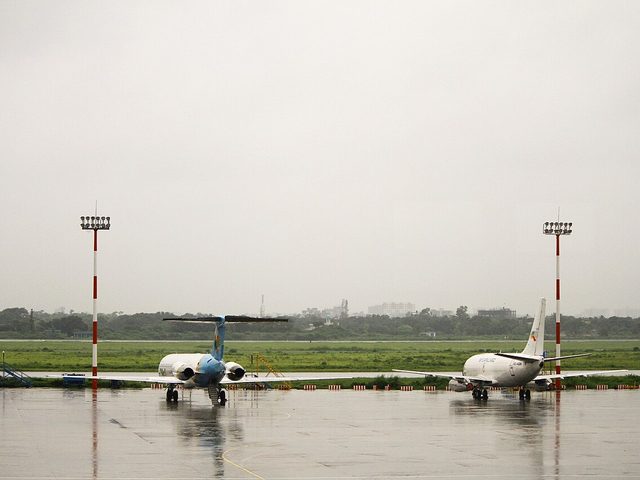
Boeing-Mcdonnell Douglas Boeing (Douglas) Md 83
Twin Jet· 89 globally registered
The McDonnell Douglas MD-83 is the longest-range and most powerful member of the DC-9 Super 80 family, a stretched twin-jet that dominated short-to-medium-haul routes throughout the 1980s and 1990s. Introduced in 1985, the MD-83 featured uprated Pratt & Whitney JT8D-219 engines producing 21,000 pounds of thrust each and additional fuel capacity in the rear cargo hold, giving it a range of approximately 2,500 nautical miles, enough to connect transcontinental city pairs that earlier DC-9 variants couldn't reach economically. American Airlines became the type's largest operator, eventually flying more than 360 MD-80-series aircraft and making the distinctive rear-mounted engine roar a signature sound at hubs like Dallas-Fort Worth and Chicago O'Hare. The MD-83's design prioritized hot-and-high performance, with its powerful engines allowing operations from challenging airports like Mexico City and Denver with full passenger loads. The aircraft seats 155 to 172 passengers in typical two-class configurations, with a cruise speed of Mach 0.76 and a service ceiling of 37,000 feet. Its aft-mounted engines and clean wing design provided excellent short-field performance, though the unducted JT8D turbojets made it significantly louder than modern high-bypass turbofans. The cockpit retained analog instrumentation through most of the production run, with optional electronic flight instrument systems available in later builds. By the 2000s, rising fuel costs and increasingly stringent noise regulations began pushing the MD-83 toward retirement despite its rugged reliability. The type's fuel consumption ran roughly 35 percent higher than newer Airbus A320 and Boeing 737NG competitors, and Stage 3 noise compliance required hushkit modifications in many jurisdictions. American Airlines retired its last MD-83 in September 2019, marking the end of the type's mainline U.S. service, though the aircraft remains popular with cargo operators and charter carriers who value its spacious fuselage and proven dispatch reliability. SkyMeter has tracked 146 flights across 14 airframes and 4 operators, with ARCTIC ONE LLC the largest observed operator.
Safety in context
The incident rate counts flights with ANY safety event detected by SkyMeter: go-arounds (a routine response, not a failure), unstable-approach gate flags (advisory thresholds), rejected takeoffs (the system working as designed), and runway events. It is NOT an accident rate or fatality rate. For accident statistics, refer to the NTSB Aviation Accident Database (USA) or the Aviation Safety Network. See methodology for what each event type measures.
Performance
Speed envelope & approach
Dimensions
Airframe geometry
Weight & identification
Operating limits
Top operators
By fleet size · last 7 days


Safety profile
Flagged flights · last 7 days
Recent incidents
Flagged flights of MD83

Recent flights
Real flights of MD83 · airborne ≥ 20 min