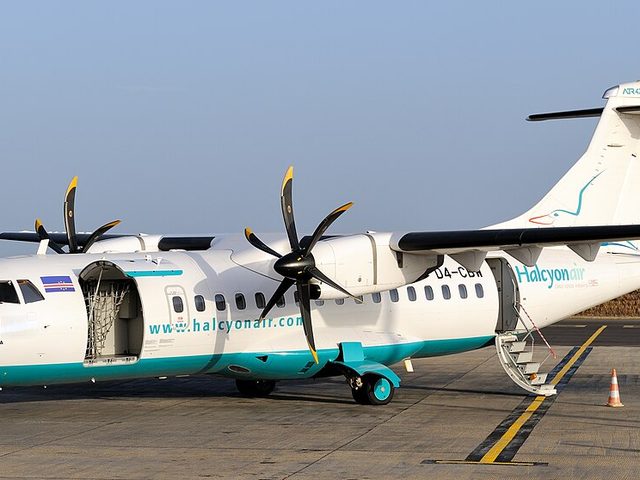
Atr 42-600
Twin Turboprop
The ATR 42-600 represents the latest evolution of Europe's most successful regional turboprop family, combining French aerodynamic design with Italian manufacturing in a partnership between Airbus and Leonardo. Launched in 2007 and entering service in 2012, the -600 variant brought new Pratt & Whitney PW127XT engines, a glass cockpit, and improved cabin comfort to the proven ATR 42 airframe that first flew in 1984. With seating for 48 passengers in typical configuration, the type carved out a niche serving thin routes and island communities where jet economics don't work. Its fuel burn is roughly half that of comparable regional jets on sectors under 300 nautical miles. The aircraft's high-wing configuration and rugged landing gear make it particularly suited to unpaved or short runways, while its maximum cruise speed of 270 knots and range of 800 nautical miles cover the vast majority of regional route networks. Operating from sea level to airports at 8,000 feet, the ATR 42-600 thrives in hot-and-high conditions that challenge piston twins, yet costs significantly less to operate than turbofan alternatives. The type has found favor with carriers serving Japan's island chains, Scandinavian fjord communities, and Caribbean inter-island routes where frequency matters more than speed. ATR's focus on operational simplicity shows in the -600's systems: hydraulically actuated flight controls, proven PT6-family engines, and straightforward maintenance requirements that allow operation from remote bases without extensive ground support. The aircraft's relatively low approach speed of around 100 knots and docile handling characteristics make it accessible to pilots transitioning from smaller turboprops, while its STOL performance opens airports that jets cannot serve. SkyMeter has tracked 1,091 flights across 43 airframes and 1 operators, with the largest observed operator.
Safety in context
The incident rate counts flights with ANY safety event detected by SkyMeter: go-arounds (a routine response, not a failure), unstable-approach gate flags (advisory thresholds), rejected takeoffs (the system working as designed), and runway events. It is NOT an accident rate or fatality rate. For accident statistics, refer to the NTSB Aviation Accident Database (USA) or the Aviation Safety Network. See methodology for what each event type measures.
Performance
Speed envelope & approach
Dimensions
Airframe geometry
Weight & identification
Operating limits
Top operators
By fleet size · last 7 days
No operator data available.
Safety profile
Flagged flights · last 7 days
Recent incidents
Flagged flights of AT46


Recent flights
Real flights of AT46 · airborne ≥ 20 min


