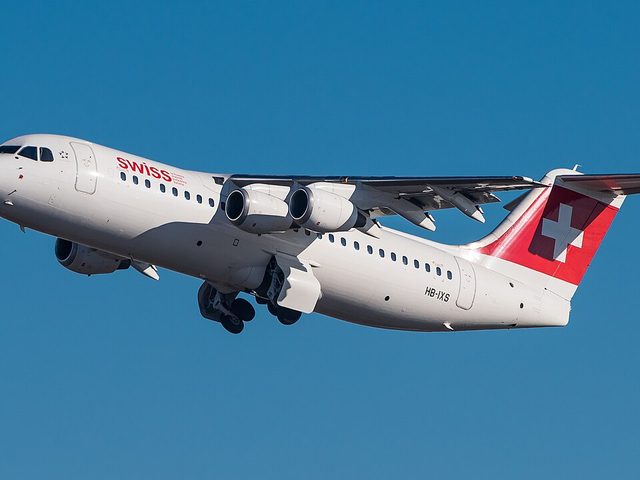
British Aerospace Bae 146-100
Quad Jet· 2 globally registered
The British Aerospace 146-100 is the original and shortest member of the BAe 146 family, a distinctive four-engine regional jet that entered service in 1983. Nicknamed the "Whisperjet" for its exceptionally quiet Lycoming ALF 502 turbofans, the 146 was designed for operations into challenging airports with short runways, steep approaches, and noise-sensitive urban environments like London City Airport. Its high-mounted wing, four engines, and rugged landing gear made it uniquely capable among regional jets of its era, able to operate from unpaved strips and handle demanding mountain airfields that larger twins could not safely serve. The -100 variant seats 70-85 passengers and was the launch model, though it was eventually outsold by the stretched -200 and -300 versions. What made the type genuinely unusual was its four-engine configuration at a time when twin-engine designs dominated regional aviation, a choice driven by hot-and-high performance requirements and the need for steep approach capability rather than pure economics. The aircraft's low approach speeds and excellent field performance came at the cost of higher fuel burn per seat compared to contemporary twins, but for operators serving difficult airports or requiring maximum payload flexibility, the trade-off was worthwhile. Today, many BAe 146s have found second careers as aerial firefighting tankers, a role that exploits their slow-speed handling, multi-engine redundancy, and ability to operate from remote airstrips near wildfire zones. The type's large cabin volume accommodates substantial retardant loads, while its four engines provide the power needed for rapid climbs out of mountain valleys. Neptune Aviation Services has been a major operator of 146 air tankers in North America, converting passenger airframes into specialized firefighting platforms capable of delivering up to 3,000 gallons of retardant per drop. SkyMeter has tracked 11 flights across 1 airframes and 1 operators, with NEPTUNE AVIATION SERVICES INC the largest observed operator.
Safety in context
The incident rate counts flights with ANY safety event detected by SkyMeter: go-arounds (a routine response, not a failure), unstable-approach gate flags (advisory thresholds), rejected takeoffs (the system working as designed), and runway events. It is NOT an accident rate or fatality rate. For accident statistics, refer to the NTSB Aviation Accident Database (USA) or the Aviation Safety Network. See methodology for what each event type measures.
Performance
Speed envelope & approach
Dimensions
Airframe geometry
Weight & identification
Operating limits
Top operators
By fleet size · last 7 days

Safety profile
Flagged flights · last 7 days
Family
Related variants
Recent incidents
Flagged flights of B461
Recent flights
Real flights of B461 · airborne ≥ 20 min