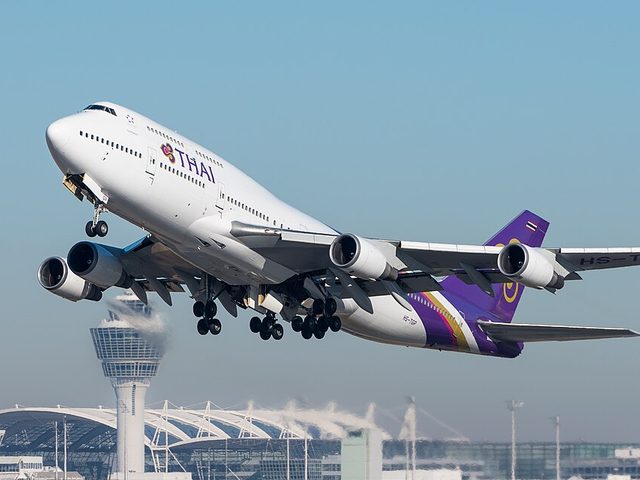
Boeing 747-100
Quad Jet· 5 globally registered
The Boeing 747-100 was the world's first widebody airliner and the first twin-aisle jet, revolutionizing long-haul air travel when it entered service with Pan Am in 1970. With its distinctive humpbacked upper deck and four high-bypass turbofan engines, the 747 could carry more than twice as many passengers as any previous airliner, slashing the cost per seat-mile and making intercontinental travel accessible to millions. The original -100 variant had a maximum takeoff weight of 735,000 pounds and a range exceeding 5,300 nautical miles, enabling nonstop transoceanic routes that were previously impossible or uneconomical. Its cavernous fuselage and high-mounted wing made it ideal for cargo operations, and the type quickly became the backbone of global freight networks. The 747's performance envelope was equally impressive for its era: a maximum operating speed of Mach 0.92 and a service ceiling of 45,000 feet, allowing it to cruise above most weather and traffic. While the -100 was soon superseded by longer-range and higher-capacity variants, it remained in specialized service for decades. NASA famously converted two 747-100SR airframes into Shuttle Carrier Aircraft, mounting the Space Shuttle orbiter atop the fuselage for ferry flights between landing sites and Kennedy Space Center, a role that required structural reinforcement and unique handling characteristics but showcased the 747's versatility. SkyMeter has tracked flights across airframes and operators, with the largest observed operator.
Safety in context
The incident rate counts flights with ANY safety event detected by SkyMeter: go-arounds (a routine response, not a failure), unstable-approach gate flags (advisory thresholds), rejected takeoffs (the system working as designed), and runway events. It is NOT an accident rate or fatality rate. For accident statistics, refer to the NTSB Aviation Accident Database (USA) or the Aviation Safety Network. See methodology for what each event type measures.
Performance
Speed envelope & approach
Dimensions
Airframe geometry
Weight & identification
Operating limits
Top operators
By fleet size · last 7 days
No operator data available.
Safety profile
Flagged flights · last 7 days
No safety data available.
Family
Related variants
Recent flights
Real flights of B741 · airborne ≥ 20 min
