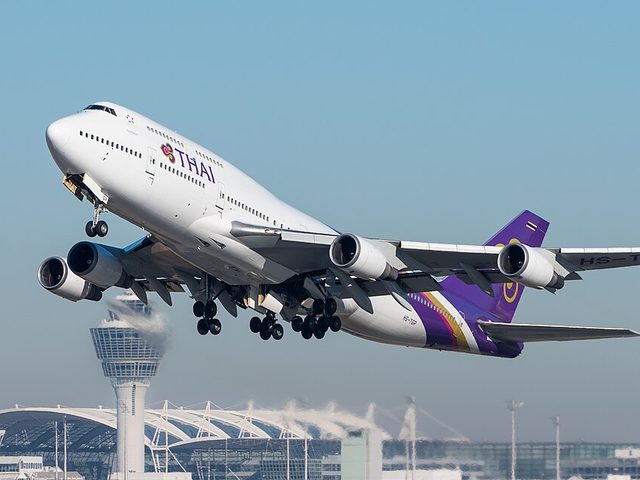
Boeing 747-400
Quad Jet· 125 globally registered
The Boeing 747-400 is the most successful variant of the iconic 'Queen of the Skies' widebody, introduced in 1989 as a technological leap over earlier 747 classics. It brought winglets, a glass cockpit, and extended range that allowed nonstop flights like Los Angeles to Melbourne, cementing the type's dominance on long-haul trunk routes throughout the 1990s and 2000s. With seating for 416 passengers in three-class configuration and a maximum takeoff weight of 875,000 pounds, the -400 became the backbone of intercontinental travel for carriers worldwide, from British Airways to Qantas to Cathay Pacific. Its four high-bypass turbofans and distinctive hump made it instantly recognizable at any airport. Though passenger operations have largely wound down in favor of twin-engine widebodies like the 777 and 787, the 747-400 found a lucrative second career as a freighter. The -400F and passenger-to-freighter conversions dominate heavy cargo operations today, prized for their 248,000-pound payload capacity and nose-loading capability. Atlas Air, Cargolux, and Kalitta Air operate substantial fleets on intercontinental cargo routes, moving everything from electronics to pharmaceuticals to live horses. The type's high cruise speed of Mach 0.85 and 7,260-nautical-mile range make it ideal for time-sensitive freight, while its four-engine redundancy remains valued on long overwater sectors. The 747-400's flight deck was revolutionary for its era, replacing the flight engineer with automated systems and introducing electronic flight instrument displays that reduced crew workload. Maximum operating speed is 365 knots indicated or Mach 0.92, with a service ceiling of 45,100 feet, higher than most contemporary widebodies. Approach speeds typically sit around 156 knots at normal landing weights, with full-flap stall at 115 knots. These performance margins, combined with excellent handling characteristics, made the type popular with pilots despite its size. SkyMeter has tracked 1,875 flights across 199 airframes and 23 operators, with ATLAS AIR INC the largest observed operator.
Safety in context
The incident rate counts flights with ANY safety event detected by SkyMeter: go-arounds (a routine response, not a failure), unstable-approach gate flags (advisory thresholds), rejected takeoffs (the system working as designed), and runway events. It is NOT an accident rate or fatality rate. For accident statistics, refer to the NTSB Aviation Accident Database (USA) or the Aviation Safety Network. See methodology for what each event type measures.
Performance
Speed envelope & approach
Dimensions
Airframe geometry
Weight & identification
Operating limits
Top operators
By fleet size · last 7 days


Safety profile
Flagged flights · last 7 days
Family
Related variants
Recent incidents
Flagged flights of B744


Recent flights
Real flights of B744 · airborne ≥ 20 min


