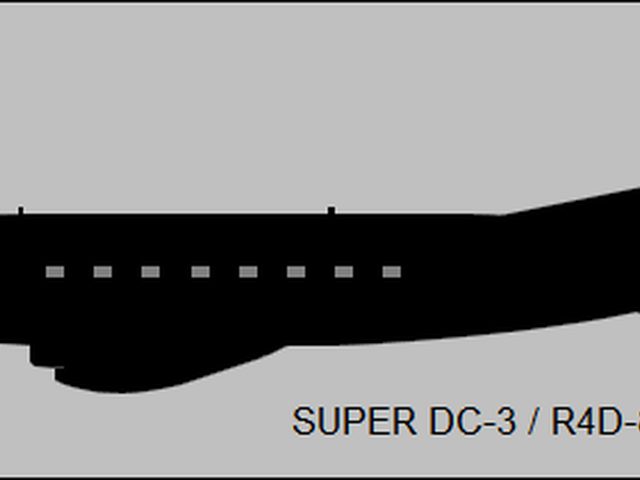
Douglas Super Dc-3
Twin Piston· 7 globally registered
The Douglas DC-3S Super DC-3 represents the final evolution of aviation's most iconic transport aircraft. Introduced in 1949 as a complete modernization of the legendary DC-3, the Super DC-3 featured a swept vertical stabilizer, more powerful Wright R-1820 Cyclone engines producing 1,475 horsepower each, a strengthened fuselage, and improved aerodynamics that increased cruise speed to 270 mph and service ceiling to 24,000 feet. Despite these substantial improvements over the original 1930s design, the Super DC-3 arrived too late to capture the market. Airlines were already transitioning to turbine-powered aircraft, and only 100 Super DC-3s were built, most as military conversions of existing C-47s for the U.S. Navy. What makes the DC-3S particularly notable today is its extreme rarity in active service. While thousands of standard DC-3s and C-47s still fly worldwide, the Super DC-3 variant is exceptionally uncommon, with only a handful remaining airworthy. The type's swept tail and extended fuselage make it instantly recognizable to aviation enthusiasts. The Super DC-3 could carry 30 passengers compared to the original's 21, and its improved performance made it viable for longer routes and higher-altitude operations that challenged the standard DC-3. The DC-3S designation specifically identifies this rare Super variant, distinguishing it from the thousands of standard DC-3s still registered under the base DC3 type code. Operators of these aircraft today are typically cargo haulers, charter services, or warbird collectors who appreciate the type's unique place in aviation history as the bridge between the piston-era workhorse and the coming jet age. SkyMeter has tracked flights across airframes and operators, with the largest observed operator.
Safety in context
The incident rate counts flights with ANY safety event detected by SkyMeter: go-arounds (a routine response, not a failure), unstable-approach gate flags (advisory thresholds), rejected takeoffs (the system working as designed), and runway events. It is NOT an accident rate or fatality rate. For accident statistics, refer to the NTSB Aviation Accident Database (USA) or the Aviation Safety Network. See methodology for what each event type measures.
Performance
Speed envelope & approach
Dimensions
Airframe geometry
Weight & identification
Operating limits
Top operators
By fleet size · last 7 days
No operator data available.
Safety profile
Flagged flights · last 7 days
No safety data available.
Family
Related variants
Recent incidents
Flagged flights of DC3S

Recent flights
Real flights of DC3S · airborne ≥ 20 min