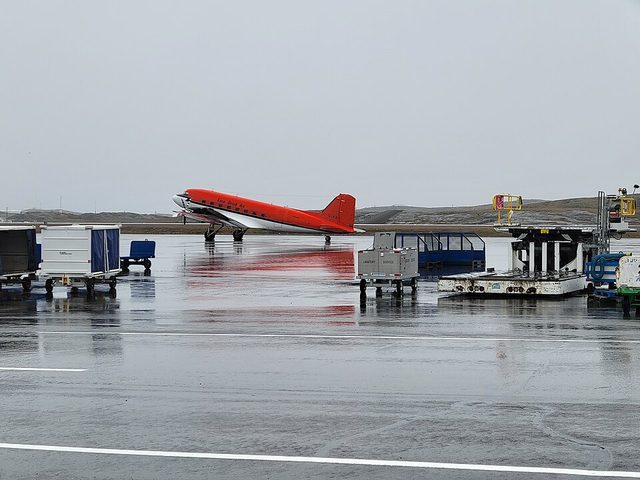
Douglas/Basler Basler, Bt-67 Turbo 67
Twin Turboprop
The Douglas DC-3, first flown in 1935, revolutionized air transport and remains one of aviation's most enduring designs. Nearly nine decades after its debut, hundreds still fly commercially and in utility roles worldwide. The DC-3T variant represents a modern turboprop conversion, typically replacing the original Pratt & Whitney R-1830 radial piston engines with Pratt & Whitney Canada PT6A turboprops, dramatically improving reliability, fuel efficiency, and high-altitude performance while preserving the airframe's legendary ruggedness. These conversions extend the operational life of an aircraft that helped establish the economics of airline travel in the 1930s and served as the military C-47 Skytrain workhorse throughout World War II, dropping paratroopers over Normandy and supplying forces across every theater. The turboprop conversion transforms the DC-3's capabilities: PT6A engines deliver better single-engine performance, reduced maintenance, and the ability to burn readily available Jet-A fuel instead of scarce 100LL avgas. Cruise speeds remain modest at around 160-180 knots, but the type excels in short-field operations, unprepared strips, and harsh environments, precisely the missions that keep DC-3Ts flying in remote regions of Canada, Alaska, and developing nations. Maximum takeoff weight for most conversions hovers around 28,000 pounds, with typical payloads of 6,000-8,000 pounds depending on configuration. The aircraft's low stall speed, benign handling, and ability to operate from gravel and grass runways make it irreplaceable for cargo, skydiving, and specialty charter work where no modern replacement offers the same combination of capacity, durability, and operating economics on marginal airstrips. SkyMeter has tracked 81 flights across 15 airframes and 10 operators, with KENN BOREK AIR LTD the largest observed operator.
Safety in context
The incident rate counts flights with ANY safety event detected by SkyMeter: go-arounds (a routine response, not a failure), unstable-approach gate flags (advisory thresholds), rejected takeoffs (the system working as designed), and runway events. It is NOT an accident rate or fatality rate. For accident statistics, refer to the NTSB Aviation Accident Database (USA) or the Aviation Safety Network. See methodology for what each event type measures.
Performance
Speed envelope & approach
Dimensions
Airframe geometry
Weight & identification
Operating limits
Top operators
By fleet size · last 7 days


Safety profile
Flagged flights · last 7 days
Family
Related variants
Recent incidents
Flagged flights of DC3T

Recent flights
Real flights of DC3T · airborne ≥ 20 min

