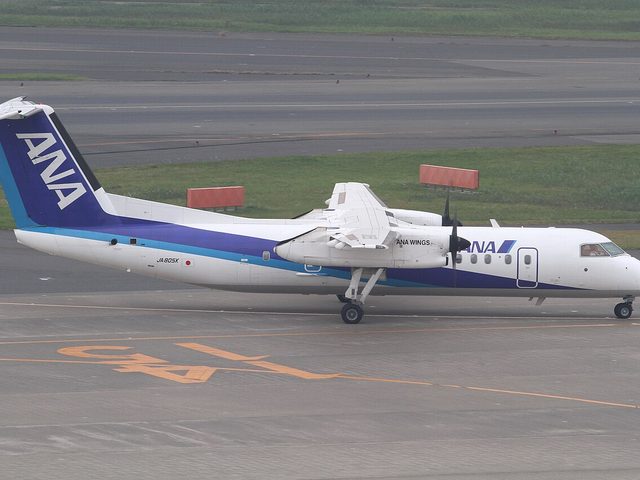
Dehavilland Canada Dash 8/Dhc8-300
Twin Turboprop· 26 globally registered
The Bombardier Dash 8-300, introduced in 1989, represents the stretched mid-capacity variant of the iconic DHC-8 family, seating 50-56 passengers compared to the Series 100's 37-40. Developed by de Havilland Canada and later acquired by Bombardier, the -300 extended the fuselage by 11 feet while retaining the proven Pratt & Whitney Canada PW123 turboprops that deliver 2,380 shaft horsepower each. The type carved out a niche in regional markets requiring more capacity than the -100 but better field performance than jets, particularly across mountainous terrain and shorter runways throughout Canada, Australia, New Zealand, and Alaska. What distinguishes the Dash 8-300 from competing regional turboprops is its combination of speed and economics: cruising at 328 knots true airspeed, it operates nearly as fast as regional jets while burning significantly less fuel on sectors under 500 nautical miles. The aircraft's high wing and rugged landing gear allow operations into unpaved and marginal strips, making it a workhorse for carriers serving remote communities. Its active noise and vibration suppression system, while not as advanced as the later Q400's, still provided a quieter cabin than earlier-generation turboprops like the Fokker F27. The -300 saw production of 267 aircraft between 1989 and 2009, when Bombardier shifted focus entirely to the larger Q400. While many have been retired or converted to freighters, the type remains in frontline service with regional carriers in the South Pacific, Canada's north, and niche operators worldwide. Its 19,500-pound payload capacity and ability to operate from runways as short as 4,000 feet keep it relevant for thin routes where jet economics don't pencil out. SkyMeter has tracked 1,300 flights across 92 airframes and 28 operators on routes, with PERIMETER AVIATION LP AS REPRESENTED BY ITS GENERAL PARTNER, PER (PAG) the largest observed operator.
Safety in context
The incident rate counts flights with ANY safety event detected by SkyMeter: go-arounds (a routine response, not a failure), unstable-approach gate flags (advisory thresholds), rejected takeoffs (the system working as designed), and runway events. It is NOT an accident rate or fatality rate. For accident statistics, refer to the NTSB Aviation Accident Database (USA) or the Aviation Safety Network. See methodology for what each event type measures.
Performance
Speed envelope & approach
Dimensions
Airframe geometry
Weight & identification
Operating limits
Top operators
By fleet size · last 7 days


Safety profile
Flagged flights · last 7 days
Recent incidents
Flagged flights of DH8C


Recent flights
Real flights of DH8C · airborne ≥ 20 min


