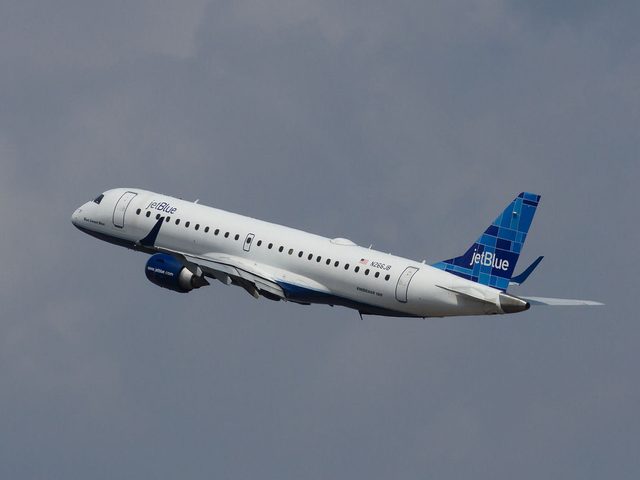
Embraer 190
Twin Jet· 126 globally registered
The Embraer E190 is the largest member of Brazil's E-Jet family, a clean-sheet regional jet design that redefined the 70-to-110-seat market when it entered service in 2005. Unlike the stretched derivatives that dominated regional aviation in the 1990s, the E190 was purpose-built from the outset as a modern, fly-by-wire aircraft with a spacious two-by-two cabin layout that eliminated the dreaded middle seat, a feature passengers noticed immediately and airlines used in marketing. Its wing design and General Electric CF34-10E engines deliver exceptional hot-and-high performance, making it a favorite for carriers operating from challenging airports in Latin America, Africa, and mountainous regions of Asia. What sets the E190 apart from competitors like the Bombardier CRJ900 is its mainline-jet feel in a regional airframe. The aircraft's 28,000-foot initial cruise altitude capability, 2,400-nautical-mile range, and relatively quiet cabin made it a bridge aircraft: large enough for trunk routes but efficient enough for thin markets. Launch customer JetBlue deployed it to open point-to-point routes that couldn't sustain narrowbody economics, while carriers like Air Canada and KLM Cityhopper used it to replace aging Fokker 70s and BAe 146s. The type's success spawned the second-generation E190-E2 in 2018, but the original E190 remains in widespread service, prized for its dispatch reliability and lower acquisition costs on the used market. The E190's operating envelope reflects its dual role as both a regional workhorse and a small mainline jet. Its maximum operating speed of 320 knots IAS and Mach 0.82 matches that of larger narrowbodies, while approach speeds around 132 knots keep it compatible with regional airports. The aircraft's 51,800-pound maximum landing weight and sturdy landing gear allow it to operate from runways as short as 5,200 feet, and its 41,000-foot service ceiling provides flexibility to top weather and optimize fuel burn on longer sectors. Operators appreciate the commonality with the smaller E175 and E170, which share the same type rating and allow efficient crew rostering across the E-Jet fleet. SkyMeter has tracked 4,861 flights across 279 airframes and 10 operators, with ALLIANCE AIRLINES PTY LIMITED the largest observed operator.
Safety in context
The incident rate counts flights with ANY safety event detected by SkyMeter: go-arounds (a routine response, not a failure), unstable-approach gate flags (advisory thresholds), rejected takeoffs (the system working as designed), and runway events. It is NOT an accident rate or fatality rate. For accident statistics, refer to the NTSB Aviation Accident Database (USA) or the Aviation Safety Network. See methodology for what each event type measures.
Performance
Speed envelope & approach
Dimensions
Airframe geometry
Weight & identification
Operating limits
Top operators
By fleet size · last 7 days


Safety profile
Flagged flights · last 7 days
Recent incidents
Flagged flights of E190


Recent flights
Real flights of E190 · airborne ≥ 20 min


