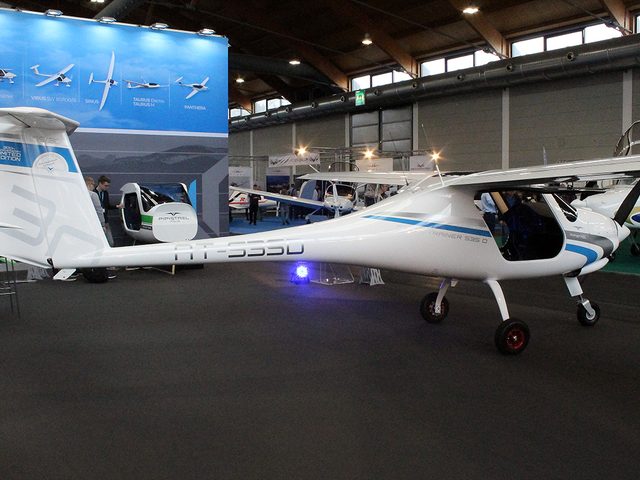
Pipistrel Alpha Trainer
Single Piston
The Piper PA-28 Archer is one of general aviation's most enduring training and personal aircraft, with continuous production spanning more than five decades since its 1963 introduction as part of the Cherokee family. The PA-28-181 variant, powered by a 180-horsepower Lycoming O-360 engine, emerged in the mid-1970s and became the backbone of flight schools worldwide thanks to its forgiving handling, simple systems, and durable all-metal construction. Piper built the Archer with a low wing, fixed tricycle gear, and a spacious four-seat cabin that balances economy with comfort, making it equally suited to primary training, time-building, and weekend cross-country trips. The Archer's operating envelope is modest but practical: cruise speeds around 120 knots, a service ceiling near 13,000 feet, and a range of roughly 400 nautical miles with reserves. Its stall characteristics are benign, with full-flap stall speed around 49 knots, and the aircraft's wide cockpit and excellent visibility make it popular among student pilots transitioning from smaller trainers. The type has seen incremental refinements over the years: the Archer II introduced a semi-tapered wing in 1977, the Archer III added a more streamlined cowling in the 1990s, and the current Archer TX and LX models feature Garmin glass cockpits, but the core airframe remains fundamentally unchanged, a testament to the original design's soundness. SkyMeter has tracked 763 flights across 104 airframes and 43 operators, with ELEMENTAL AVIATION LC the largest observed operator.
Safety in context
The incident rate counts flights with ANY safety event detected by SkyMeter: go-arounds (a routine response, not a failure), unstable-approach gate flags (advisory thresholds), rejected takeoffs (the system working as designed), and runway events. It is NOT an accident rate or fatality rate. For accident statistics, refer to the NTSB Aviation Accident Database (USA) or the Aviation Safety Network. See methodology for what each event type measures.
Performance
Speed envelope & approach
Dimensions
Airframe geometry
Weight & identification
Operating limits
Top operators
By fleet size · last 7 days


Safety profile
Flagged flights · last 7 days
Family
Related variants
Recent incidents
Flagged flights of PIAT


Recent flights
Real flights of PIAT · airborne ≥ 20 min


