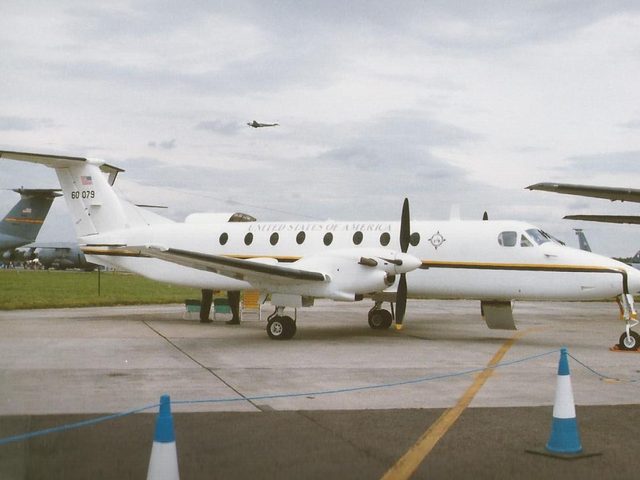
Beech 1900/C-12j
Twin Turboprop· 143 globally registered
The Beechcraft 1900D is a pressurized twin-turboprop commuter airliner that became the workhorse of regional aviation across North America from the early 1990s onward. Developed as a stretched, stand-up-cabin variant of the original 1900, the 1900D introduced a distinctive raised roofline that allowed passengers to walk upright in the aisle, a rare luxury in 19-seat commuters and a major selling point for airlines operating short-haul routes in Alaska, the Canadian Arctic, and the rural United States. Powered by two Pratt & Whitney Canada PT6A-67D engines producing 1,279 shaft horsepower each, the aircraft cruises at around 280 knots and can operate from short, unpaved strips while maintaining cabin pressurization up to 25,000 feet, making it ideal for mountainous terrain and harsh climates where larger jets cannot venture. Beechcraft delivered over 300 examples of the 1900D between 1991 and 2002, and the type remains in widespread service with cargo operators, charter companies, and a handful of scheduled passenger carriers. Its rugged landing gear, large cargo door, and ability to carry nearly 4,500 pounds of payload have kept it relevant in freight and medical evacuation roles long after most passenger airlines transitioned to regional jets. The 1900D's handling characteristics are straightforward for pilots transitioning from smaller twins, though its long fuselage and relatively narrow track demand attention during crosswind landings. Maximum operating speed is 266 knots indicated, with approach speeds typically around 110 knots depending on weight and configuration. SkyMeter has tracked 1,391 flights across 185 airframes and 46 operators, with ALPINE AVIATION INC the largest observed operator.
Safety in context
The incident rate counts flights with ANY safety event detected by SkyMeter: go-arounds (a routine response, not a failure), unstable-approach gate flags (advisory thresholds), rejected takeoffs (the system working as designed), and runway events. It is NOT an accident rate or fatality rate. For accident statistics, refer to the NTSB Aviation Accident Database (USA) or the Aviation Safety Network. See methodology for what each event type measures.
Performance
Speed envelope & approach
Dimensions
Airframe geometry
Weight & identification
Operating limits
Top operators
By fleet size · last 7 days


Safety profile
Flagged flights · last 7 days
Family
Related variants
No related variants.
Recent incidents
Flagged flights of B190
Recent flights
Real flights of B190 · airborne ≥ 20 min


