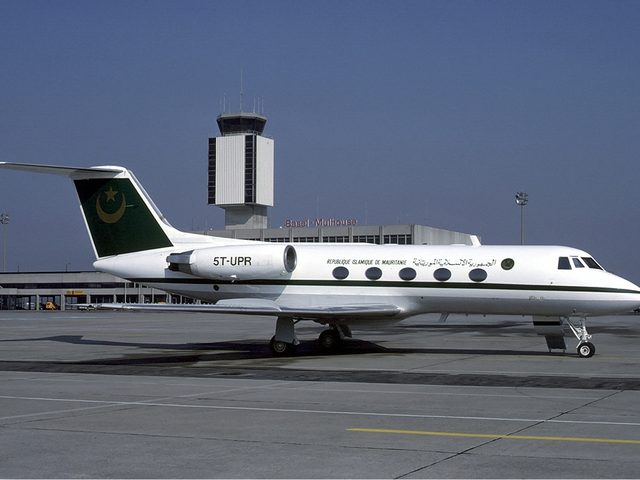
Gulfstream Aerospace Gulfstream Ii
Twin Jet· 29 globally registered
The Gulfstream II, introduced in 1966, was the first purpose-built business jet capable of true intercontinental range, establishing Gulfstream as the gold standard in corporate aviation. Powered by twin Rolls-Royce Spey turbofans, the G-II could carry eight to nineteen passengers nonstop from New York to Paris or Los Angeles to Tokyo, a revolutionary capability that redefined executive travel and set the template for every long-range business jet that followed. Its swept wing and powerful engines delivered a maximum cruise speed of Mach 0.85 and a service ceiling of 43,000 feet, performance that remained competitive well into the 1980s. Over its production run from 1967 to 1979, Gulfstream built 256 G-IIs, many of which remain in service today after multiple refurbishments and avionics upgrades. The type found roles beyond corporate transport: NASA operates several as research platforms (including the famous SOFIA airborne observatory's predecessor aircraft), while others serve in cargo, medical evacuation, and government transport roles. The G-II's rugged airframe and reliable Spey engines have proven remarkably durable, with some airframes accumulating over 20,000 flight hours across five decades of operation. The Gulfstream II's legacy extends far beyond its own service life. It directly spawned the G-III, G-IV, and G-V lineage that dominates the ultra-long-range business jet market today. Its combination of range, speed, and cabin comfort established the benchmark that competitors still chase, and its influence is visible in every modern business jet from the Bombardier Global series to the Dassault Falcon 7X. SkyMeter has tracked 15 flights across 7 airframes and 6 operators, with MAGIC JOHNSON ENTERTAINMENT INC the largest observed operator.
Safety in context
The incident rate counts flights with ANY safety event detected by SkyMeter: go-arounds (a routine response, not a failure), unstable-approach gate flags (advisory thresholds), rejected takeoffs (the system working as designed), and runway events. It is NOT an accident rate or fatality rate. For accident statistics, refer to the NTSB Aviation Accident Database (USA) or the Aviation Safety Network. See methodology for what each event type measures.
Performance
Speed envelope & approach
Dimensions
Airframe geometry
Weight & identification
Operating limits
Top operators
By fleet size · last 7 days


Safety profile
Flagged flights · last 7 days
Family
Related variants
Recent incidents
Flagged flights of GLF2


Recent flights
Real flights of GLF2 · airborne ≥ 20 min

