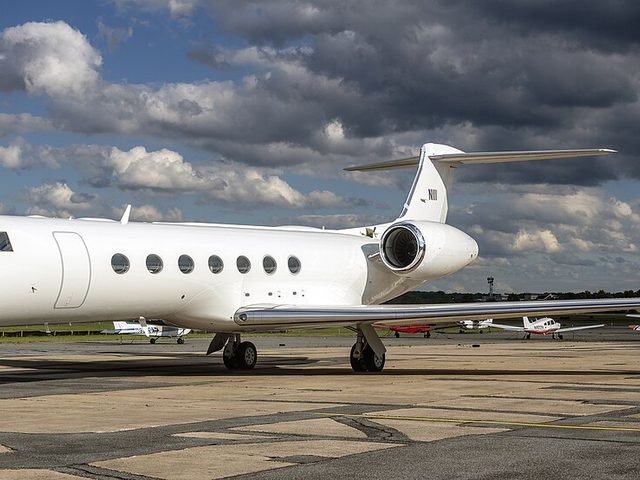
Gulfstream Aerospace Gulfstream V
Twin Jet· 154 globally registered
The Gulfstream V redefined intercontinental business aviation when it entered service in 1997 as the world's first purpose-built ultra-long-range corporate jet capable of nonstop flights exceeding 6,500 nautical miles. Gulfstream designed the G-V around two Rolls-Royce BR710 turbofans and a supercritical wing optimized for high-altitude cruise, enabling it to operate routinely at Flight Level 510 (higher than most airliners), where thinner air and favorable winds deliver exceptional fuel efficiency and speed. The type set multiple city-pair records during its certification campaign, including a headline-grabbing nonstop flight from Detroit to Tokyo that demonstrated its ability to connect any two cities on Earth with at most one refueling stop. Powered by engines producing 14,750 pounds of thrust each, the G-V cruises at Mach 0.80 with a maximum operating speed of Mach 0.885, covering transcontinental and transoceanic routes at altitudes where weather and traffic are rarely factors. Its 90,500-pound maximum takeoff weight supports a typical cabin configuration for 12 to 16 passengers in stand-up comfort, with full galley and lavatory amenities for flights lasting up to 14 hours. The cockpit features a Honeywell Primus 2000 avionics suite with dual flight management systems and enhanced vision capabilities, reflecting the late-1990s state of the art in business jet automation. Beyond corporate transport, the G-V serves as the airframe for several military and government variants, including the C-37A VIP transport for senior U.S. officials and the NAOC (National Airborne Operations Center) backup command post. Its combination of range, speed, and high-altitude performance made it the natural successor to earlier Gulfstreams and established the template for the G550 and subsequent models. SkyMeter has tracked 1,609 flights across 492 airframes and 256 operators, with TVPX AIRCRAFT SOLUTIONS INC TRUSTEE the largest observed operator.
Safety in context
The incident rate counts flights with ANY safety event detected by SkyMeter: go-arounds (a routine response, not a failure), unstable-approach gate flags (advisory thresholds), rejected takeoffs (the system working as designed), and runway events. It is NOT an accident rate or fatality rate. For accident statistics, refer to the NTSB Aviation Accident Database (USA) or the Aviation Safety Network. See methodology for what each event type measures.
Performance
Speed envelope & approach
Dimensions
Airframe geometry
Weight & identification
Operating limits
Top operators
By fleet size · last 7 days


Safety profile
Flagged flights · last 7 days
Family
Related variants
Recent incidents
Flagged flights of GLF5


Recent flights
Real flights of GLF5 · airborne ≥ 20 min


