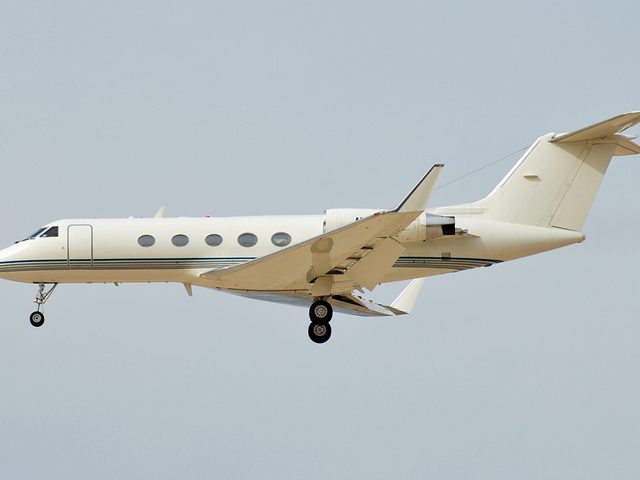
Gulfstream Aerospace Gulfstream Iii
Twin Jet· 74 globally registered
The Gulfstream III revolutionized long-range business aviation when it entered service in 1979 as the first purpose-built intercontinental corporate jet capable of nonstop transatlantic crossings. Gulfstream stretched the fuselage of its earlier GII design, added winglets for improved efficiency, and fitted more powerful Rolls-Royce Spey engines, creating an aircraft that could carry eight passengers 4,200 nautical miles at Mach 0.85. The GIII became the template for modern ultra-long-range business jets and served as the basis for numerous military variants including the C-20 executive transport and the E-11A battlefield communications platform. NASA's Armstrong Flight Research Center operates several Gulfstream IIIs as airborne laboratories and chase aircraft, using their high-altitude capability (ceiling 45,000 feet) and speed to support experimental flight test programs at Edwards Air Force Base. The type's spacious cabin and long endurance make it ideal for carrying research instrumentation and flight test engineers during envelope expansion work on prototype aircraft. Beyond government research, the GIII found favor with corporations and charter operators seeking reliable transoceanic range, though most have since been retired or upgraded to GIV/GV standards. Production ended in 1986 after 202 aircraft were built, but the design's DNA lives on in every modern Gulfstream: the G650 and G700 are direct descendants of the GIII's pioneering long-range architecture. The type remains notable for its solid systems, excellent high-altitude performance, and the distinctive winglets that became a Gulfstream signature. SkyMeter has tracked 17 flights across 6 airframes and 6 operators, with SANDY WINGS LLC the largest observed operator.
Safety in context
The incident rate counts flights with ANY safety event detected by SkyMeter: go-arounds (a routine response, not a failure), unstable-approach gate flags (advisory thresholds), rejected takeoffs (the system working as designed), and runway events. It is NOT an accident rate or fatality rate. For accident statistics, refer to the NTSB Aviation Accident Database (USA) or the Aviation Safety Network. See methodology for what each event type measures.
Performance
Speed envelope & approach
Dimensions
Airframe geometry
Weight & identification
Operating limits
Top operators
By fleet size · last 7 days


Safety profile
Flagged flights · last 7 days
Family
Related variants
Recent incidents
Flagged flights of GLF3

Recent flights
Real flights of GLF3 · airborne ≥ 20 min