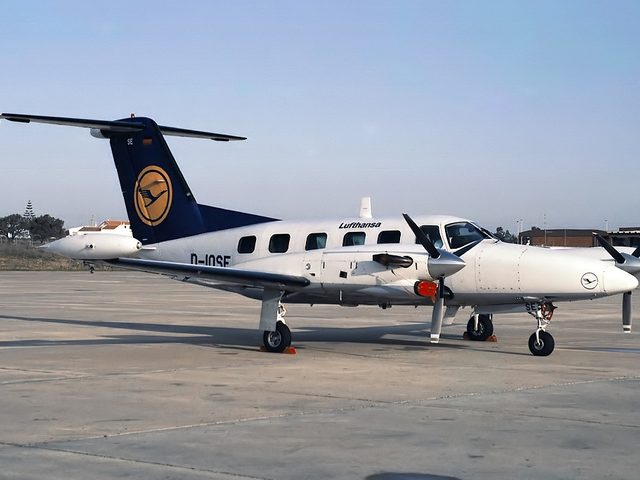
Piper Cheyenne 2
Twin Piston· 111 globally registered
The Piper PA-42 Cheyenne III represents the pinnacle of Piper's pressurized turboprop twin line, introduced in 1979 as a step-up from the earlier Cheyenne II. Powered by two Pratt & Whitney Canada PT6A-41 engines producing 720 shaft horsepower each, the Cheyenne III offered owner-pilots and small charter operators a genuine cabin-class experience with stand-up headroom, club seating for six to eight passengers, and a private aft lavatory, capabilities previously reserved for much larger aircraft. The IIIA variant, which appeared in 1983, added a distinctive T-tail and stretched fuselage, improving stability and cabin volume while maintaining the type's reputation for solid high-altitude performance with a service ceiling of 29,000 feet and cruise speeds around 300 knots. What distinguished the Cheyenne III in its era was its positioning as a serious business tool that could be flown single-pilot under Part 91, yet offered near-turbofan comfort and range (roughly 1,400 nautical miles with reserves). The aircraft found favor with corporate flight departments, air ambulance operators, and cargo feeders who needed pressurization, known-icing capability, and the ability to operate from shorter runways than competing jets. Production ended in 1993 after approximately 180 Cheyenne IIIs and IIIAs were built, but the type remains active in charter, medevac, and owner-flown roles across the Americas and beyond. SkyMeter has tracked 86 flights across 34 airframes and 20 operators, with Great Lakes Gliding Corporation the largest observed operator.
Safety in context
The incident rate counts flights with ANY safety event detected by SkyMeter: go-arounds (a routine response, not a failure), unstable-approach gate flags (advisory thresholds), rejected takeoffs (the system working as designed), and runway events. It is NOT an accident rate or fatality rate. For accident statistics, refer to the NTSB Aviation Accident Database (USA) or the Aviation Safety Network. See methodology for what each event type measures.
Performance
Speed envelope & approach
Dimensions
Airframe geometry
Weight & identification
Operating limits
Top operators
By fleet size · last 7 days


Safety profile
Flagged flights · last 7 days
Family
Related variants
Recent incidents
Flagged flights of PAY2


Recent flights
Real flights of PAY2 · airborne ≥ 20 min


