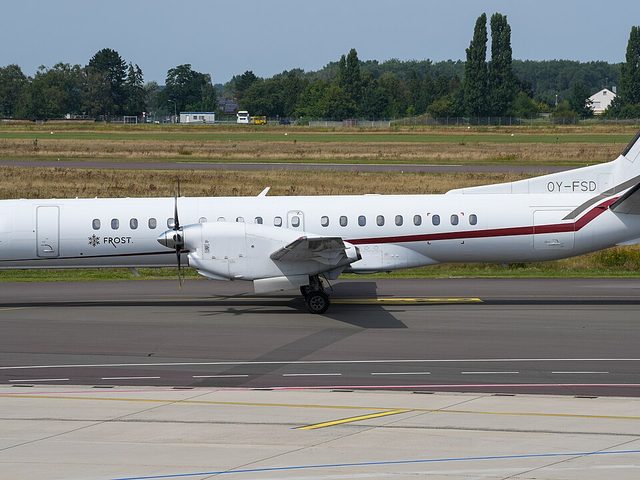
Saab 2000
Single Turboprop· 11 globally registered
The Saab 2000 stands as one of the fastest turboprops ever built for commercial service, designed to bridge the gap between conventional turboprops and regional jets. Developed by Sweden's Saab Aircraft in the early 1990s as a stretched, higher-performance successor to the Saab 340, the 2000 entered service in 1994 with a cruise speed of 370 knots, nearly jet-like performance that earned it the nickname "the turboprop that thinks it's a jet." Powered by twin Rolls-Royce AE 2100A engines driving six-blade composite propellers, the aircraft seats 50-58 passengers and was engineered for rapid 300-500 nautical mile regional hops where its speed advantage over competitors like the ATR 72 could shine. Despite its technical sophistication and impressive performance envelope (including a maximum operating speed of 285 knots IAS and service ceiling of 31,000 feet), the Saab 2000 struggled commercially against the rising tide of 50-seat regional jets in the late 1990s. Only 63 aircraft were built before production ended in 1999, making it a relatively rare sight today. The type found a niche in corporate shuttle operations, charter work, and specialized cargo roles where its combination of speed, pressurized comfort, and short-field capability remains valuable. Its high wing loading and powerful engines give it excellent ride quality in turbulence, though approach speeds around 120 knots are notably higher than slower turboprops. Today the Saab 2000 operates primarily in corporate and charter fleets, with a handful still flying scheduled passenger service in regional markets. SkyMeter has tracked 169 flights across 18 airframes and 5 operators, with BANK OF UTAH TRUSTEE the largest observed operator.
Safety in context
The incident rate counts flights with ANY safety event detected by SkyMeter: go-arounds (a routine response, not a failure), unstable-approach gate flags (advisory thresholds), rejected takeoffs (the system working as designed), and runway events. It is NOT an accident rate or fatality rate. For accident statistics, refer to the NTSB Aviation Accident Database (USA) or the Aviation Safety Network. See methodology for what each event type measures.
Performance
Speed envelope & approach
Dimensions
Airframe geometry
Weight & identification
Operating limits
Top operators
By fleet size · last 7 days


Safety profile
Flagged flights · last 7 days
Family
Related variants
Recent incidents
Flagged flights of SB20


Recent flights
Real flights of SB20 · airborne ≥ 20 min

