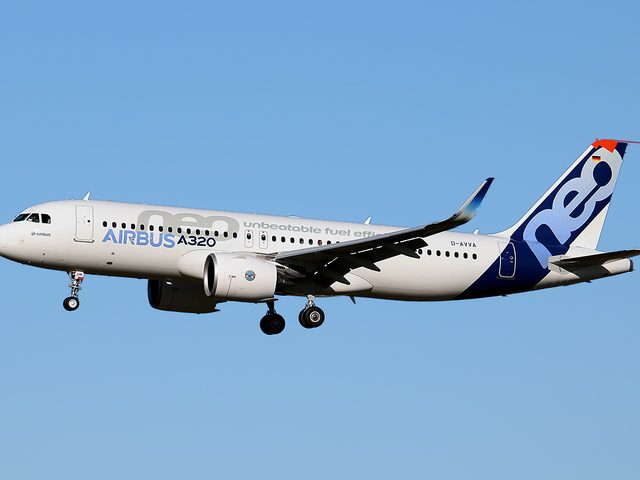
Airbus A320 Neo
Twin Jet· 147 globally registered
The Airbus A320neo represents the most successful re-engining program in commercial aviation history, combining the proven A320 airframe with next-generation powerplants to deliver 15-20% fuel savings and dramatic noise reductions. Launched in 2010 and entering service with Lufthansa in 2016, the neo (new engine option) family offers operators a choice between CFM International's LEAP-1A or Pratt & Whitney's geared turbofan PW1100G, both incorporating advanced materials and aerodynamics including distinctive sharklet wingtips. The type has become the backbone of low-cost and full-service carriers worldwide, with over 8,000 orders making it the fastest-selling commercial aircraft program ever. Operationally, the A320neo maintains the original's 39,000-foot ceiling and Mach 0.82 cruise while extending range to 3,400 nautical miles, enabling new transatlantic and transcontinental routes previously requiring larger twins. The aircraft's commonality with earlier A320ceo models allows mixed-fleet operations with minimal additional training, a key selling point for airlines managing transition fleets. Its advanced avionics, fly-by-wire controls, and spacious 150-180 seat cabin in typical two-class configuration have made it the direct competitor to Boeing's 737 MAX family, with both types now dominating the single-aisle market. The neo's environmental credentials extend beyond fuel efficiency: its engines meet ICAO Chapter 14 noise standards with margins, cutting the acoustic footprint by 50% compared to previous-generation aircraft. This has opened noise-restricted airports to increased operations and made the type particularly attractive in Europe and Asia where environmental regulations continue tightening. The aircraft's dispatch reliability has matured to match the industry-leading ceo family, though early PW1100G-powered examples faced teething issues that Pratt & Whitney has since largely resolved through hardware updates and improved maintenance protocols. SkyMeter has tracked 35,152 flights across 1,887 airframes and 14 operators spanning routes, with BANK OF UTAH TRUSTEE the largest observed operator.
Safety in context
The incident rate counts flights with ANY safety event detected by SkyMeter: go-arounds (a routine response, not a failure), unstable-approach gate flags (advisory thresholds), rejected takeoffs (the system working as designed), and runway events. It is NOT an accident rate or fatality rate. For accident statistics, refer to the NTSB Aviation Accident Database (USA) or the Aviation Safety Network. See methodology for what each event type measures.
Performance
Speed envelope & approach
Dimensions
Airframe geometry
Weight & identification
Operating limits
Top operators
By fleet size · last 7 days


Safety profile
Flagged flights · last 7 days
Recent incidents
Flagged flights of A20N


Recent flights
Real flights of A20N · airborne ≥ 20 min


