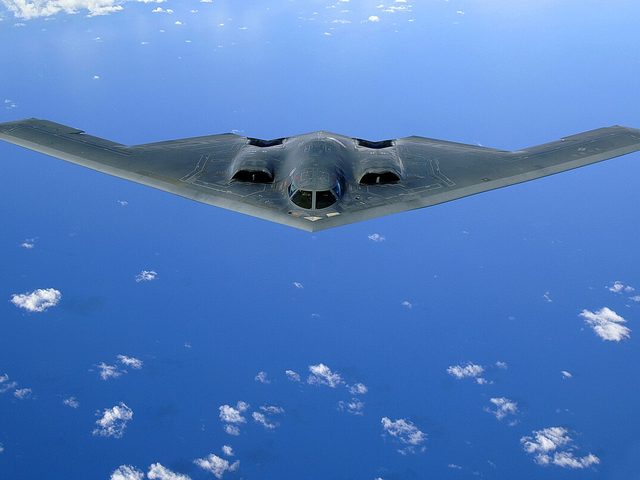
Northrop B-2 Spirit
Quad Jet· 21 globally registered
The Northrop Grumman B-2 Spirit is the world's only operational stealth strategic bomber, representing the pinnacle of low-observable aircraft design. Introduced in 1997 after more than a decade of classified development, the B-2's flying wing configuration eliminates vertical surfaces and integrates radar-absorbent materials throughout its composite structure, making it virtually invisible to conventional air defense systems. Only 21 were built due to extraordinary unit costs exceeding two billion dollars each, making it the most expensive aircraft ever produced by procurement price. The Spirit can penetrate sophisticated integrated air defenses that would be lethal to conventional bombers, delivering both conventional and nuclear weapons with precision from altitudes up to 50,000 feet. Its four General Electric F118 turbofan engines are buried deep within the wing to mask infrared signatures, and the entire airframe is maintained in climate-controlled hangars to preserve the radar-absorbent coatings. The B-2 can fly unrefueled missions exceeding 6,000 nautical miles and has demonstrated its strategic reach in combat operations from Kosovo to Afghanistan to Libya, often launching from Whiteman Air Force Base in Missouri and striking targets halfway around the world with mid-air refueling. The aircraft's two-person crew operates in a pressurized cockpit with provisions for long-duration missions, and its advanced avionics include synthetic aperture radar for all-weather precision targeting. Despite its 1980s-era design origins, ongoing upgrades to sensors, communications, and weapons integration keep the B-2 relevant as the backbone of America's strategic bomber fleet until the B-21 Raider enters service in the coming years.
Safety in context
The incident rate counts flights with ANY safety event detected by SkyMeter: go-arounds (a routine response, not a failure), unstable-approach gate flags (advisory thresholds), rejected takeoffs (the system working as designed), and runway events. It is NOT an accident rate or fatality rate. For accident statistics, refer to the NTSB Aviation Accident Database (USA) or the Aviation Safety Network. See methodology for what each event type measures.
Performance
Speed envelope & approach
Dimensions
Airframe geometry
Weight & identification
Operating limits
Top operators
By fleet size · last 7 days
No operator data available.
Safety profile
Flagged flights · last 7 days
No safety data available.
Recent flights
Real flights of B2 · airborne ≥ 20 min
No recent flights match these filters.